

The short answer? Yes. $750,000 at 60 is one of the balances where the question genuinely flips. Below the ASFA benchmarks, the question is whether retirement works. At $750K, which clears ASFA’s comfortable lump sums for both singles ($630,000) and couples ($730,000), the questions become how good the lifestyle can be, and how to handle the Age Pension assets test, because $750K sits in the exact zone where structuring decisions are worth real money.
On our standard assumptions, a single homeowner can spend $45,000 to $50,000 a year for life, or fund the full ASFA comfortable standard into their late 80s. A couple on $750K combined can spend $60,000 to $65,000 a year for life, with the full Age Pension arriving at 67 in every scenario we modelled. This guide runs the numbers level by level and covers the assets test wrinkle that catches singles at exactly this balance.
Where $750K sits against the benchmarks
Preservation age is 60 for anyone born after 30 June 1964, so with a condition of release met, the balance is accessible tax-free from a taxed fund. The basics are covered in How retirement works in Australia.
Against the benchmarks, $750K is a strong position. ASFA’s June quarter 2026 lump sums for a comfortable retirement at 67 are $630,000 for a single homeowner and $730,000 for a couple, with the comfortable budgets at $56,166 and $78,998 a year. Source: ASFA Retirement Standard. Current as at September 2026. A single at $750K is above the benchmark with room to spare. A couple is just over it, though the benchmark assumes retiring at 67, and retiring at 60 adds seven unsupported years, which is where the modelling below matters.
One honest caveat on those seven years: the ASFA lump sums assume the Age Pension starts helping straight away. Retire at 60 and the balance carries everything alone until 67, so the same $750K supports a comfortable single retirement but sits below what a couple needs for the full comfortable budget from 60. The numbers below show exactly where the lines fall.
The seven-year gap: what survives to 67
From 60 to 67, super does all the work. Assuming a balanced return of about 5% a year after fees and spending rising with 2.5% inflation, here is roughly what remains at 67:
| Annual spending (today’s dollars) | Approximate balance at 67 |
|---|---|
| $45,000 | $640,000 |
| $50,000 | $595,000 |
| $55,000 | $550,000 |
| $60,000 | $505,000 |
| $65,000 | $460,000 |
Please note: All figures, projections and scenarios in this article are approximate and for illustrative purposes only. Individual outcomes will vary based on personal circumstances, investment returns, fees, spending and current government policy. This is general information, not personal advice.
How long will $750K really last?
Single homeowner, retiring at 60 with $750K. The table includes the part Age Pension our model estimates in the first year of eligibility, in today’s dollars, because at this balance the pension is not all-or-nothing. It scales with what remains:
| Annual spending (today’s dollars) | Money lasts until roughly | Estimated part pension at 67 (today’s dollars) |
|---|---|---|
| $45,000 | Beyond age 100 | ~$11,000 a year |
| $50,000 | Around 100 | ~$15,000 a year |
| $55,000 | Around 90 | ~$18,500 a year |
| $60,000 | Mid 80s | ~$22,000 a year |
At the full ASFA comfortable single budget of $56,166 a year, the model runs to the late 80s. In other words, a single homeowner at $750K can genuinely live the comfortable standard from 60, with the trade-off being less certainty past 90.
Couple (homeowners), retiring at 60 with $750K combined:
| Annual spending (today’s dollars) | Money lasts until roughly |
|---|---|
| $55,000 to $60,000 | Beyond age 100 |
| $65,000 | Around 100 |
| $70,000 | Late 80s |
| $75,000 | Around 80 |
The couple story at this balance is the strength of the floor underneath it. In every scenario above, the couple arrives at 67 with assessable assets below the full-pension threshold, which means the full couple pension of $48,516 a year (as at September 2026) stacks on top of whatever super remains. That floor is why $60,000 to $65,000 a year holds for life on the model, while the full ASFA comfortable couple budget of $78,998 pushes depletion back to around 80.
The assets test wrinkle singles hit at exactly this balance
Here is the detail that makes $750K different from $500K or $1 million for a single. From 20 September 2026, a single homeowner loses the Age Pension entirely at $745,750 in assessable assets, with the full pension available under $333,000 and a taper of $3 a fortnight per $1,000 in between. Source: Services Australia. Current as at September 2026. These figures are set by the Australian Government and are typically updated each March and September.
Read that first number again. At today’s settings, a single who arrived at age 67 still holding $750K would receive no pension at all. But retiring at 60 changes the picture completely: seven years of drawdown, plus thresholds that index upward over that time, land every sensible spending scenario comfortably inside part-pension territory by 67. The drawdown is not just funding your 60s. It is quietly converting a nil entitlement into $11,000 to $22,000 a year of indexed government income for the rest of your life.
The flip side is the taper. In part-pension territory, every extra $1,000 of assessable assets costs $78 a year of pension, which is why decisions like where money sits between partners, gifting timing and home upgrades can shift the entitlement by thousands a year at this balance. Scott and Phil covered the structuring opportunities in the Age Pension opportunities episode, and this is the core of our pension and Centrelink advice.
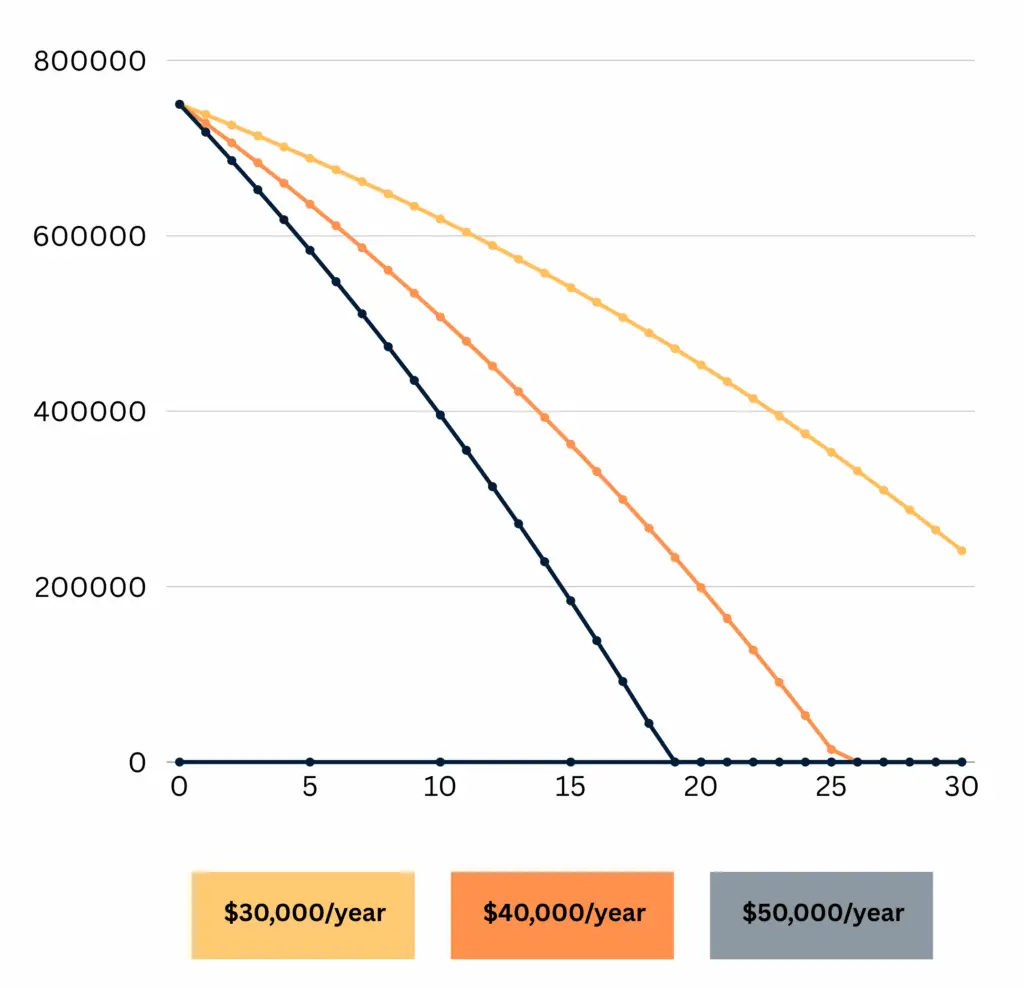
This Line Chart Depletion of $750K across 30 years under $30K, $40K, and $50K spending levels.
The bigger risk at $750K: underspending
At $500K, the planning conversation is about not running out. At $750K, we generally find the opposite problem: retirees who have cleared the benchmarks but keep living like they haven’t, skipping the travel years they saved for because the balance dropping feels wrong. Scott put it directly on The Psychology of Money episode:
“The goal isn’t to die with the largest super balance possible. The goal is to convert capital into confident living.” The tables above are the antidote: a single spending $50,000 a year and a couple spending $65,000 are funded to around 100 on reasonable assumptions, with the pension floor underneath. Spending to the plan is not recklessness at this balance. It is the point of having saved it.
The other lever is still the investment mix. The money has to last 30 to 40 years from 60, and Scott and Phil have shown on the early retirement episode how much difference the settings make: their modelling of retiring one year earlier turned a plan funded to 105 into one that ran out at 79. Most retirees at this balance keep a couple of years of spending defensive and leave the rest invested for the long haul. Whether any particular mix suits your situation depends on individual factors.
Want to see your own version of these tables? Run your numbers through the free Wealthlab super calculator. It takes two minutes and beats guessing.
Frequently asked questions
Can I retire at 60 with $750K in super? For most homeowners, yes, and with more comfort than the balances below it. A single spending $45,000 to $50,000 a year, or a couple spending $60,000 to $65,000 combined, stays funded for life on our assumptions, with Age Pension support layering in from 67.
Is $750K enough for a comfortable retirement in Australia? It clears ASFA’s comfortable lump sums for both singles ($630,000) and couples ($730,000), as at the June quarter 2026 standard. For a single retiring at 60, the full comfortable budget of $56,166 a year is fundable into the late 80s. For a couple retiring at 60, the comfortable budget of $78,998 depletes the balance by around 80, so most couples at this balance land between modest and comfortable. We break down the benchmarks in what a comfortable retirement in Australia costs.
Will I get the Age Pension if I retire at 60 with $750K? Not until 67, and here the balance matters. A single holding $750K in assessable assets at 67 would sit above the current cut-off of $745,750 and receive nothing at today’s settings. But retiring at 60 and drawing down means arriving at 67 well inside part-pension territory, typically worth $11,000 to $22,000 a year depending on spending. A couple with $750K combined sits far below the couple cut-off of $1,121,000 and, after moderate drawdown, typically qualifies for the full pension. Figures as at September 2026.
How long will $750K last if I retire at 60? On a balanced return of about 5% a year with inflation-indexed spending and pension entitlements included: for a single, beyond 100 at $45,000 a year, to around 90 at $55,000 and the mid 80s at $60,000. For a couple, $60,000 to $65,000 a year holds to around 100 or beyond, while $75,000 runs out around 80.
Can a couple retire at 60 with $750K combined? Yes, and the full couple pension from 67 is the quiet engine. Spending of $60,000 to $65,000 a year is the workable-for-life zone on our assumptions. Above $70,000, the gap years bite harder and depletion moves into the 80s.
Is it still worth planning around the Age Pension with $750K? Very much so, especially for singles, who sit in the taper zone where each $1,000 of assessable assets costs $78 a year of pension. How assets are split between partners, when large purchases happen and how the home fits in can shift the entitlement by thousands a year. That structuring is worth reviewing before 67, not after.
Making the most of $750K
$750,000 at 60 is one of the stronger starting positions for retirement in Australia. The question isn’t whether you can retire. It’s how to structure things so the money works as hard as possible across a 25 to 30 year horizon. Investment mix, drawdown timing, Age Pension structuring and estate planning all matter more at this balance than at lower amounts, because there’s more to optimise and more to protect.
If any of this has raised questions about your own situation, book a free chat with the Wealthlab team. No pressure, no jargon.