

Retiring at 62 with $465,000 in super is a question more Australians are asking than you might think. It’s a realistic balance for someone who entered the workforce before compulsory super reached its current rates, who may have had career breaks or periods of part-time work, and who is now looking at a retirement that’s close enough to plan seriously.
The short answer is yes, $465K at 62 can fund retirement, particularly for a homeowner. But “can I retire” and “will I be comfortable” are two different questions, and the gap between them depends on how well you manage the five-year bridge to Age Pension eligibility, how your super is invested, and what your actual spending looks like.
Here’s how the numbers play out.
Super Access at 62: What the Rules Actually Say
At 62, you’ve passed preservation age. For anyone born after 1 July 1964, preservation age is 60. You can access your full super balance tax-free, provided you have retired from the workforce or ceased an employment arrangement.
Withdrawals from a taxed super fund after age 60 attract zero income tax. No income tax on lump sums, no income tax on account-based pension income. This is one of the most tax-effective features of the Australian retirement system, and at $465,000 it means your entire balance is available to you without giving any of it to the ATO.
Source: ATO: Super withdrawal options (Current as at May 2026)
Please note: All figures, projections and scenarios in this article are for general illustration only. Individual outcomes depend on personal circumstances, spending levels, investment returns, fees and government policy. This is general information, not personal advice.
How Far Does $465K Actually Go?
The most useful way to look at this is not “how many years does it last in isolation” but “what income does it produce, at what spending level, and what does the picture look like when the Age Pension arrives at 67?”
The table below models $465,000 in an account-based pension at a net return of approximately 5% per year after fees and investment tax, which is consistent with a balanced investment option.
| Annual spending | Estimated balance at age 67 | Combined income from 67 (super + Age Pension estimate) |
|---|---|---|
| $25,000/yr | ~$385,000 | ~$44,000 to $48,000/yr |
| $30,000/yr | ~$320,000 | ~$42,000 to $46,000/yr |
| $35,000/yr | ~$255,000 | ~$40,000 to $44,000/yr |
| $42,000/yr | ~$160,000 | ~$36,000 to $40,000/yr |
The Age Pension estimates assume a single homeowner qualifying for a part or full pension based on remaining assets at 67. These are indicative ranges, not guarantees, and depend on the assets and income tests applying at that time.
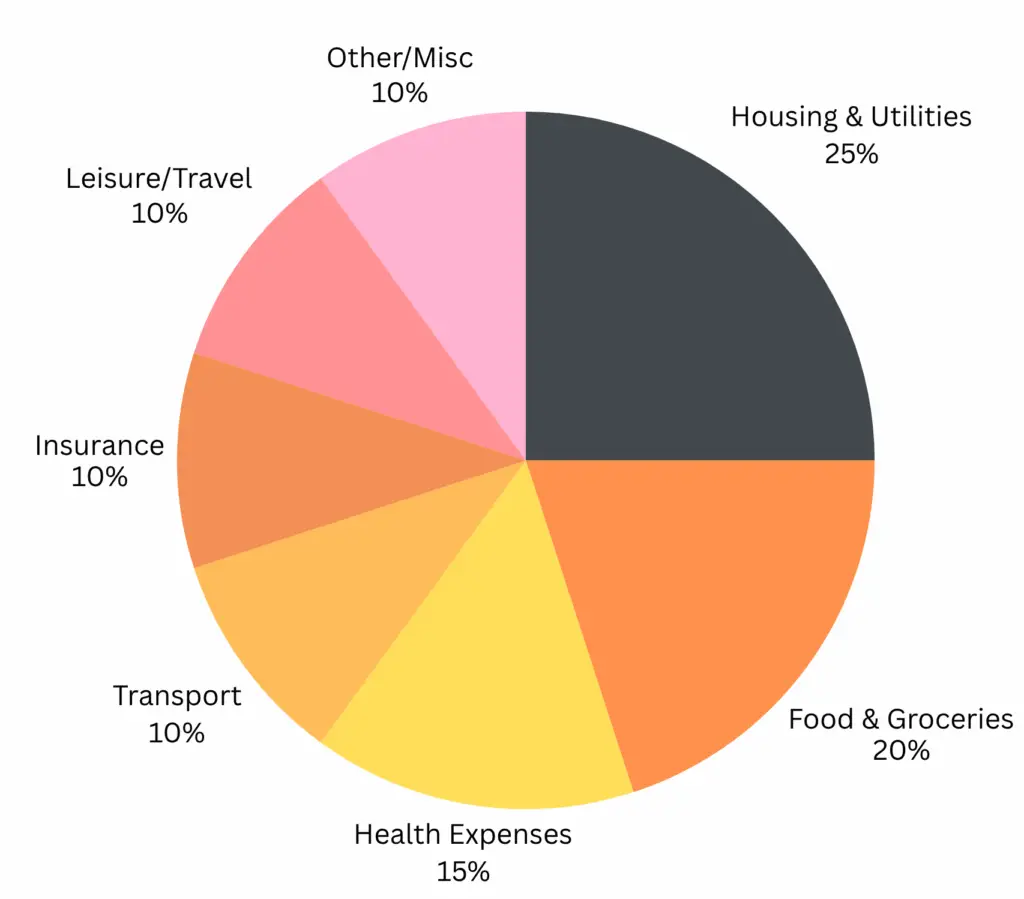
The key insight from the table: even at $42,000 per year in spending, you arrive at 67 with $160,000 remaining and likely qualify for a substantial Age Pension. Combined retirement income from 67 is still meaningful, and from that point the Age Pension gradually takes on more of the load as super reduces over time.
This structure focuses on essentials, yet still allows for occasional travel and leisure a realistic lifestyle for many Australians retiring at 62.
The 62 to 67 Gap: Planning the Bridge Years
This is where most people underestimate the pressure. Retiring at 62 means five full years with no employer SG contributions coming in, no government support, and your entire income needs met from super.
At $30,000 per year, that’s $150,000 drawn down over the bridge period before the Age Pension even starts. On a $465K balance, that’s a meaningful chunk. This is not a reason not to retire. It’s a reason to plan those five years with intention.
The three things that make the biggest difference during the bridge:
1. What you’re invested in. A 62-year-old’s money needs to last potentially 25 to 30 years. Many Australians switch everything to cash or a conservative option when they retire because it feels safer. The reality is that at 5% per year in a balanced fund versus 2% in cash, the difference over five years on $465K is roughly $70,000 in extra growth. Being too conservative in the early years of retirement is one of the most common and costly mistakes. Scott and Phil covered this in detail in Episode 1 of the Wealthlab Podcast: “Why Playing It Safe in Retirement Can Cost You More.”
2. When you convert to pension phase. The day you retire, your super should move from accumulation phase (where earnings are taxed at up to 15%) to pension phase (where earnings are completely tax-free). This is not automatic. You need to contact your fund and start an account-based pension. Every month you delay is a month of paying 15% tax on earnings you didn’t have to pay.
3. Whether you draw from super or have other income first. If you have savings outside super, term deposits, an investment property, or modest part-time income, drawing from those first while keeping super invested can meaningfully improve your position at 67. Every year of continued investment growth on the $465K without drawdown is worth approximately $23,000 at a 5% return.
What Lifestyle Does $465K Support for a Retiree at 62?
The answer depends significantly on whether you own your home.
Homeowner with no mortgage:
$465K comfortably supports a modest to mid-range lifestyle. Drawing $28,000 to $33,000 per year covers groceries, utilities, a reliable car, basic private health insurance, regular social activities and annual domestic travel. It’s not the ASFA comfortable standard ($54,837 per year for single homeowners), but it’s a real and liveable retirement without financial stress, particularly once the Age Pension supplements income from 67.
From age 67, if you’ve drawn $30,000 per year during the bridge years, you arrive with approximately $320,000 remaining. As a single homeowner, that’s below the full Age Pension threshold of $321,500 in total assets, meaning you’d be close to qualifying for the full Age Pension of approximately $29,000 per year. Combined with even a modest super drawdown of $15,000 to $18,000, total income from 67 is around $44,000 to $47,000 per year. For a homeowner with no debt, that’s a comfortable retirement by most Australians’ definition.
Still carrying a mortgage:
If you retire at 62 with $465K in super and still have a mortgage, the picture tightens considerably. Mortgage repayments eat directly into what would otherwise fund your lifestyle, and there’s no employer income to offset them. Carrying a mortgage into retirement with a moderate super balance requires very careful drawdown planning. In many cases, working an extra year or two to clear more of the mortgage before stopping is worth more than the super contributions you’d make in that time.
Renting:
Renting in retirement on $465K is the most challenging scenario. Rent of $20,000 to $28,000 per year leaves a much smaller amount for everything else, and the balance depletes faster. Renters generally need meaningfully more super than homeowners to achieve the same retirement income outcome. If you’re renting at 62 with $465K, having a clear plan for housing costs throughout retirement is essential before committing to stop work.
How $465K Compares to Australian Averages and Benchmarks
Knowing where $465K sits relative to the national picture is useful context.
Average super balance at 60 to 64 (APRA data):
- Men: approximately $396,000
- Women: approximately $313,000
At $465,000, you’re comfortably above the average for both genders at this age. You’re in better shape than the majority of Australians approaching retirement.
ASFA comfortable retirement benchmark (February 2026):
- Single homeowner at age 67: $630,000
- Couple at age 67: $730,000 combined
There’s a gap of approximately $165,000 between $465K and the single comfortable benchmark. But that gap is significantly bridged by the Age Pension, which the ASFA benchmark explicitly models as supplementing super drawdown over time. The $630,000 figure is not a hard floor below which comfortable retirement becomes impossible. It’s a benchmark assuming retirement at 67 with no government supplement in the early years.
Retiring at 62 with $465K and planning the drawdown well puts you in a position where the Age Pension fills an increasing share of your income needs over time. Many Australians live genuinely comfortable retirements on less than the ASFA benchmark with smart planning.
Source: ASFA Retirement Standard, February 2026 (Current as at May 2026)
Age Pension Eligibility: What $465K Means at 67
The Age Pension is means-tested, which means your entitlement depends on your assets and income at the time you apply. For most Australians who retire at 62 with $465K and draw conservatively, the five-year bridge period significantly reduces the assessable balance by the time Age Pension applications open at 67.
Current Age Pension assets test thresholds for homeowners (from March 2026):
| Full pension | Part pension cut-off | |
|---|---|---|
| Single | Assets below $321,500 | Assets up to ~$695,500 |
| Couple combined | Assets below $481,500 | Assets up to ~$1,045,500 |
Source: Services Australia: Age Pension (Current as at May 2026)
If you retire at 62 spending $30,000 per year, you reach 67 with approximately $320,000 in super. As a single homeowner, that’s right at the boundary of full pension eligibility. You’d likely qualify for the full Age Pension of approximately $29,000 per year (current rate including all supplements).
If you spend $35,000 per year during the bridge, you arrive at 67 with around $255,000, well within the full pension threshold, and likely qualifying for the maximum rate.
The Age Pension is not a last resort. For most Australians with moderate super balances, it’s a planned part of a retirement income strategy that makes the whole system work. Phil and Dan walked through exactly how the assets test and income test interact with super drawdowns in Episode 10 of the Wealthlab Podcast: “How the Age Pension Really Works.”
What to Do in the 12 Months Before You Retire at 62
The year before retirement is the highest-impact planning window. Decisions made here affect the next 25 years.
Review your investment option. If you’re in a conservative or cash-heavy option, consider whether a balanced or moderate growth option is more appropriate for a 25 to 30 year retirement horizon. Switching before you leave work gives more time for growth before you start drawing down.
Start an account-based pension on day one of retirement. Contact your super fund before you finish work. Set up the pension account so it activates the day you retire. Earnings become tax-free immediately, not weeks later when the paperwork catches up.
Check your insurance inside super. Most super accumulation accounts include default life and TPD cover. This insurance often does not automatically transfer to a pension account. Check what you hold and what happens to it before closing the accumulation account, particularly if you have a partner who depends on that cover.
Update your beneficiary nominations. Binding nominations expire every three years at most funds. If yours has lapsed, your super may not be distributed according to your wishes. Update it before you retire.
Get your Commonwealth Seniors Health Card sorted. Even before Age Pension age, Australian residents aged 60 and over who have retired may be eligible for the CSHC if their income is below certain thresholds. It provides cheaper medicines under the PBS, bulk-billed GP visits at many practices and various state and local government concessions. It’s consistently underutilised and genuinely reduces day-to-day retirement costs.
Model your Centrelink position at 67. Understanding now, not at 66, how your asset levels will interact with the Age Pension assets and income tests allows you to structure your drawdown in a way that maximises your pension entitlement. This is where the difference between good planning and average planning is most measurable.
Should You Retire at 62 or Work a Little Longer?
The maths of working one more year are straightforward. Each additional year of work at age 62 typically:
- Adds approximately $9,600 to $12,000 in employer SG contributions (at 12% on $80,000 to $100,000)
- Avoids $28,000 to $35,000 in super drawdown
- Allows the $465K to grow rather than shrink for one more year
- Total difference to your retirement position: approximately $55,000 to $65,000
That’s a real number. But it’s not the only number that matters.
Health, energy, and the appetite for work at 62 are all finite. The early years of retirement, when you’re healthy and active, are when discretionary spending on travel, experiences and lifestyle is highest. Retiring at 62 in good shape gives you those years. Working until 64 to build a slightly larger balance may mean a more comfortable retirement on paper but a different kind of retirement in practice.
As Scott discussed in Episode 19 of the Wealthlab Podcast: “Is Early Retirement a Trap? The $150K Gap Most Aussies Miss,” the decision of when to retire is not purely financial. The spending wave in retirement peaks in the early active years, drops in the middle years, then rises again with healthcare costs. A larger balance at 66 doesn’t necessarily produce a better retirement than a well-planned balance at 62.
This is a personal decision. The numbers are a framework, not a verdict.
Frequently Asked Questions
Can I retire at 62 with $465,000 in super in Australia?
Yes, particularly as a homeowner with no mortgage. $465K is above the national average for Australians aged 60 to 64. With a drawdown of around $28,000 to $32,000 per year in a balanced investment option, the balance can sustain you through the five-year bridge to Age Pension eligibility at 67, at which point a part or full Age Pension supplements your super income significantly.
How long will $465K in super last at 62?
In a balanced investment option earning approximately 5% per year, $465K at $30,000 per year annual spending lasts approximately 22 to 24 years in isolation. With Age Pension support from 67 supplementing your drawdown, the combined income stream can comfortably fund retirement well into your 80s and beyond.
What is the Age Pension age in Australia in 2026?
67, for anyone born on or after 1 January 1957. Retiring at 62 means five years of fully self-funded retirement before government income support becomes available.
Will I qualify for the Age Pension if I retire at 62 with $465K?
Not at 62. Age Pension eligibility starts at 67. However, if you draw $30,000 per year over the bridge years, you arrive at 67 with approximately $320,000 remaining, which puts you close to the full Age Pension threshold for a single homeowner ($321,500 in total assets). You would likely qualify for a full or near-full Age Pension from 67.
What is the comfortable retirement income in Australia in 2026?
According to the ASFA Retirement Standard (February 2026), a comfortable retirement requires approximately $54,837 per year for a single homeowner and $77,375 for a couple. The recommended super balance at age 67 to fund this is $630,000 for singles and $730,000 for couples. Both figures assume home ownership and a partial Age Pension supplement.
What happens to my super insurance when I start a pension account?
Insurance held through your accumulation account typically does not automatically transfer to a pension account. Before closing your accumulation account or switching to full pension phase, check what life, TPD and income protection cover you hold and whether it will continue. If you have health conditions, you may not be able to get equivalent cover elsewhere.
Is $465K above the average super balance for a 62-year-old in Australia?
Yes. The average super balance for men aged 60 to 64 is approximately $396,000 and for women approximately $313,000, based on APRA data. At $465,000 you’re above the national average for both genders.
See How Your Numbers Stack Up
The scenarios above are based on general assumptions. Your income, other assets, relationship status, housing situation and health all affect how the maths plays out for you specifically.
Use the free Wealthlab super calculator to model your own numbers in about two minutes. It shows how your balance tracks at different spending levels and what the Age Pension adds from 67.
If you’d like to work through a proper retirement income plan, book a free chat with the Wealthlab team. No obligation, no jargon,or take the free Wealthlab retirement quiz .