

If you’re 62 with around $455,000 in superannuation and asking whether you can retire, you’re in better shape than most Australians your age. The average super balance for men aged 60 to 64 is approximately $396,000, and for women it’s around $313,000. At $455K you’re sitting above the national average, but below the ASFA comfortable retirement benchmark of $630,000 for a single homeowner. That gap doesn’t mean retirement is off the table. It means understanding exactly what $455K funds, how to structure it, and how the Age Pension changes the picture from age 67 matters a lot.
Here’s the honest breakdown.
Can You Access Super at 62 in Australia?
Yes. Preservation age in Australia is 60 for anyone born after 1 July 1964. At 62, you’ve already passed that threshold. Provided you have retired or ceased an employment arrangement, you can access your full super balance tax-free. Withdrawals from a taxed super fund after age 60 attract zero income tax, whether you take a lump sum or start an account-based pension income stream.
This is one of the most significant tax advantages in the Australian retirement system: a $455,000 account-based pension paying you $30,000 per year generates zero income tax from age 60 onwards.
Source: ATO: Super withdrawal options (Current as at May 2026)
Please note: All figures, projections and scenarios in this article are for general illustration only. Individual outcomes depend on personal circumstances, spending levels, investment returns, fees and government policy. This is general information, not personal advice.
How Long Will $455,000 Last in Retirement?
This is the central question, and the answer depends on three things: how much you spend each year, what return your super earns while invested, and when the Age Pension starts supplementing your income at 67.
Using a net return of approximately 5% per year after fees and investment tax (consistent with a balanced account-based pension option), here is how $455,000 tracks at different spending levels:
| Annual spending | Balance at age 67 | Estimated age balance runs out |
|---|---|---|
| $25,000 per year | ~$368,000 | Mid to late 80s+ |
| $30,000 per year | ~$310,000 | Early to mid 80s |
| $38,000 per year | ~$215,000 | Late 70s to early 80s |
| $45,000 per year | ~$125,000 | Mid to late 70s |
What these numbers don’t show: From age 67, the Age Pension supplements your super drawdown. A single homeowner who reaches 67 with around $310,000 remaining qualifies for a meaningful part Age Pension, potentially $12,000 to $18,000 per year on top of their drawdown. That combination extends retirement funding by years, sometimes a decade or more beyond what the super balance alone suggests.
The right question is not “when does my super run out?” It’s “what is my combined income from super and the Age Pension at each stage of retirement?”
The Five-Year Gap: Age 62 to 67
Retiring at 62 means self-funding five years before Age Pension eligibility at 67. This is the biggest planning challenge for anyone retiring before Age Pension age, and it’s where $455K requires the most attention.
During those five years, every dollar you spend comes directly from your super. There is no government supplement, no employer SG, nothing coming in.
At $30,000 per year spending over five years, you draw approximately $150,000 from your balance before the Age Pension starts. That $150,000 also stops earning investment returns. The impact is real and worth modelling specifically.
Three strategies that help manage the bridge:
Draw conservatively in the early years. If you can keep spending closer to $25,000 to $28,000 during the 62 to 67 period, the balance arriving at Age Pension age is meaningfully larger. Even $5,000 less per year in drawdown produces a noticeably better position at 67 due to the compounding difference.
Convert to an account-based pension immediately. Do not leave $455K sitting in your super fund’s accumulation phase after you retire. In pension phase, investment earnings are completely tax-free. In accumulation phase they’re taxed at up to 15%. Switching on day one of retirement adds real return every year at no extra cost.
Consider part-time work in the early years. Even $10,000 to $15,000 in annual income from casual or part-time work during the 62 to 67 period dramatically reduces the pressure on your balance. It doesn’t have to be full-time. Two days a week consulting or tutoring can change your retirement income picture significantly.
What Lifestyle Does $455K Support at 62?
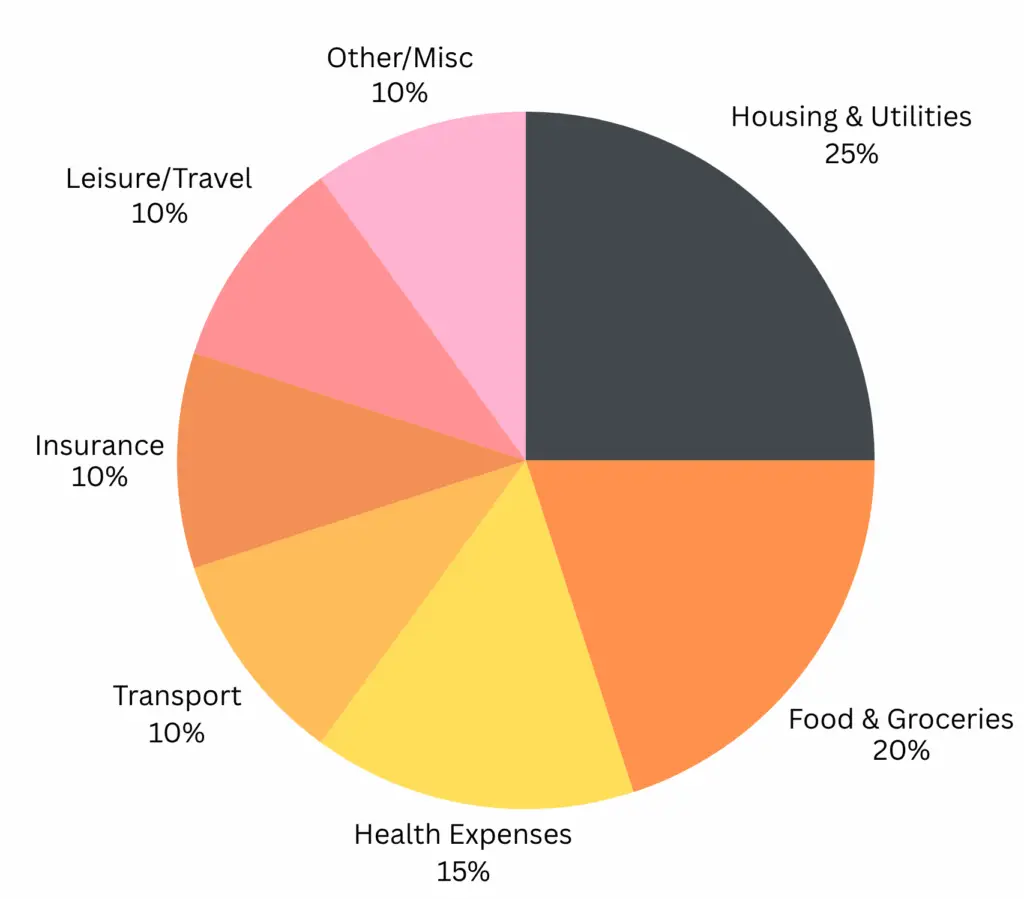
For a single homeowner with no mortgage, $455K supports a genuine retirement. Annual spending of $28,000 to $33,000 is sustainable, covering:
- Groceries and household essentials
- Utilities, rates and basic maintenance
- Basic private health insurance
- A reliable car and running costs
- Annual domestic travel, either a road trip or short interstate visit
- Regular social activities, dining out occasionally, hobbies
This is close to the ASFA modest to mid-range retirement standard. It’s not the ASFA comfortable standard ($54,837 per year for singles), but for a homeowner without debt, it’s a stable and liveable retirement that improves meaningfully from age 67 when the Age Pension adds to your income.
For a single person still renting, $455K is tight. Rent removes $18,000 to $25,000 per year from what’s available for everything else, which dramatically reduces how long the balance lasts and leaves little margin. If you’re renting at 62 and considering retirement, the maths requires close scrutiny before committing.
For a couple with combined super near $455K to $550K, the position is different because you have two sets of Age Pension eligibility, potentially two Commonwealth Seniors Health Cards, and shared fixed living costs. The couple ASFA comfortable benchmark is $730,000 combined, but a couple with $455K combined and no mortgage can still access a meaningful part Age Pension from 67 and live comfortably at a modest level.
How the Age Pension Changes the Picture at 67
Most Australians think of the Age Pension as something you either get or don’t get. In practice, it operates on a taper rate, reducing gradually as your assets rise above the threshold. Almost everyone retiring at 62 with $455K will receive something from 67, provided they’re a homeowner.
Current Age Pension assets test thresholds for homeowners (from March 2026):
| Full pension threshold | Part pension cut-off | |
|---|---|---|
| Single | Up to $321,500 in assets | Up to ~$695,500 in assets |
| Couple combined | Up to $481,500 in assets | Up to ~$1,045,500 in assets |
Source: Services Australia: Assets test (Current as at May 2026)
If you retire at 62 spending $30,000 per year, you arrive at 67 with approximately $310,000 remaining. As a single homeowner, that’s well below the full pension threshold. You may be eligible for the full Age Pension of approximately $29,000 per year (current rate as at March 2026, including all supplements).
That full pension plus a modest super drawdown of $15,000 to $20,000 per year produces a combined retirement income of $44,000 to $49,000 per year from age 67. For a homeowner with no debt, that funds a genuinely comfortable lifestyle, covering everything the ASFA modest standard does and then some.
The Age Pension is not a failure of retirement planning. It’s a deliberately designed supplement that makes the Australian system work for the majority of retirees. Using it properly is smart planning.
Is $455K Above or Below Average for a 62-Year-Old Australian?
Above average. The average super balance for Australians aged 60 to 64 is approximately $396,000 for men and $313,000 for women, based on APRA data. At $455,000, you’re ahead of most people your age.
However, the ASFA comfortable retirement benchmark of $630,000 for singles at age 67 is a useful comparison point. There is a gap of approximately $175,000 between $455K and that benchmark, which is why the Age Pension interaction, conservative drawdown and investment strategy all matter in making $455K work as intended.
The average does not equal adequate. But being above average at 62 puts you in a position where planning matters more than panic.
Retirement Planning Checklist for a 62-Year-Old With $455K
Before stopping work, work through these:
Switch to an account-based pension. Contact your super fund and start a pension phase income stream. This triggers tax-free earnings on your entire balance. Do this on day one of retirement, not later.
Check your insurance inside super. Life insurance and TPD cover held through your super accumulation account may not automatically transfer to your pension account. Check with your fund before closing the accumulation account.
Confirm your beneficiary nominations. Binding nominations expire every three years for most funds. If yours has lapsed, your super may not go where you intend. Update it before retiring.
Set your drawdown rate thoughtfully. The minimum annual drawdown for an account-based pension under age 65 is 4% of your balance. At $455,000, that’s $18,200 per year. Drawing the minimum in the early years preserves more capital for when the Age Pension starts.
Register for the Commonwealth Seniors Health Card. Even before you reach Age Pension age, at 62 you may qualify for the CSHC if your income is below certain thresholds. This provides cheaper prescriptions, bulk-billed GP visits in many practices, and state government concessions. It’s often overlooked and genuinely reduces living costs.
Plan your Centrelink position at 67. The assets test and income test interact in ways that affect how much Age Pension you receive. Understanding this before you retire, not the week before you turn 67, allows you to structure assets to maximise your entitlement.
Scott and Phil walked through exactly this kind of Age Pension structuring with real case studies in Episode 10 of the Wealthlab Podcast: “How the Age Pension Really Works”. Worth watching if you’re approaching retirement.
Should You Retire Now or Work a Bit Longer?
The financial case for working even one more year at 62 is meaningful. Each additional year at reasonable income:
- Adds approximately $9,600 to $12,000 in employer SG contributions
- Avoids approximately $28,000 to $35,000 in super drawdown
- Allows your balance to grow rather than shrink for one more year
- Combined effect: roughly $55,000 to $65,000 improvement in your position at retirement
That said, the financial case is not the whole case. Health, energy, and the years when you can most actively enjoy retirement are finite. Retiring at 62 in good health gives you active retirement years that working to 65 does not always provide. As Scott discussed in Episode 19 of the Wealthlab Podcast: “Is Early Retirement a Trap?”, the spending wave of retirement peaks in the early years when you’re active and able, then drops, then rises again with healthcare costs. The number on a spreadsheet at 67 is not the only thing that matters.
This is a personal decision that depends on your health, your work situation, and what you want your retirement to actually look like.
Frequently Asked Questions
Can I retire at 62 with $455,000 in super in Australia?
Yes, particularly if you own your home and have no mortgage. At $455K you’re above the national average for your age group. With a conservative drawdown of $28,000 to $32,000 per year and a balanced investment option, the balance can carry you through to Age Pension age at 67 with a meaningful amount remaining. From 67, a single homeowner spending $30,000 per year would likely qualify for a full or near-full Age Pension, significantly extending total retirement income.
How long will $455K in super last in retirement?
At $30,000 per year spending with a 5% annual return, $455K lasts approximately 20 to 22 years in isolation. However, from age 67 the Age Pension supplements your drawdown, meaning you can reduce your super withdrawals and extend the balance considerably beyond that estimate. For a homeowner, the combination of super and Age Pension can comfortably fund retirement well into your 80s and beyond.
Is $455K enough for a comfortable retirement in Australia?
It’s enough for a modest to mid-range retirement for a single homeowner. The ASFA comfortable retirement standard for singles at age 67 is $630,000, so there is a gap. But the ASFA standard assumes no Age Pension at the comfortable level, whereas in practice most Australians with $455K will qualify for a part or full pension from 67, which supplements income significantly.
What is the Age Pension age in Australia?
67 for anyone born on or after 1 January 1957. Retiring at 62 means five years of fully self-funded retirement before Age Pension eligibility. Planning this bridge period carefully is the central challenge of retiring before 67.
What happens to my super if I retire at 62?
You can access it tax-free once you’ve met a condition of release (retired from the workforce). Converting your balance to an account-based pension immediately is recommended, as this makes all investment earnings inside the fund completely tax-free, compared to 15% tax in the accumulation phase. You then draw a regular income from the pension account, with a minimum annual drawdown of 4% if you’re under 65.
What is the average super balance at 62 in Australia?
Approximately $396,000 for men and $313,000 for women aged 60 to 64, based on APRA data. At $455,000, you’re above the national average for both genders at this age.
Will I get the Age Pension if I retire at 62 with $455K?
Not at 62, as Age Pension eligibility starts at 67. However, if you spend down your super over the five years to 67, you may well qualify for a substantial part or full Age Pension from that point. A single homeowner drawing $30,000 per year who reaches 67 with around $300,000 to $320,000 remaining would likely be eligible for the full Age Pension of approximately $29,000 per year under the current assets test thresholds.
Work Out Your Specific Numbers
Every retirement situation is different. The scenarios above are general illustrations. Your actual income, spending pattern, health, relationship status and other assets all affect how the maths plays out.
The free Wealthlab super calculator gives you a projection based on your actual balance, age and spending in about two minutes.
If you’d like to talk through a proper retirement income plan for your specific situation, book a free chat with the Wealthlab team. No pressure, no jargon, just clarity on where you stand,or take the free Wealthlab retirement quiz .