

$390,000 in super at 60 is a workable position for a homeowner, but it demands clear eyes. Retiring at 60 means a seven-year bridge before the Age Pension starts at 67, and during those years every dollar of income comes from your own money. How long $390K lasts, what lifestyle it supports, and what the Age Pension adds from 67 are the three questions that matter.
Here is the honest breakdown.
Super Access at 60: The Rules
Preservation age is 60 for anyone born on or after 1 July 1964. Reaching 60 doesn’t automatically unlock your super, though. You also need to meet a condition of release, such as retiring or ceasing an employment arrangement after 60. The ATO‘s super guide covers the access rules and withdrawal options in detail.
The most impactful structural decision comes on day one: whether the money moves from accumulation phase to an account-based pension. In accumulation, investment earnings are taxed at up to 15%. In pension phase they are tax-free. We generally find this single switch, made promptly rather than months later, matters more to how far $390K stretches than almost any other early decision.
Please note: All figures, projections and scenarios in this article are approximate and for illustrative purposes only. Individual outcomes will vary based on personal circumstances, spending levels, investment returns, fees and current government policy. This is general information, not personal advice.
The Seven-Year Bridge
Between 60 and 67 there is no government supplement. At $30,000 a year in spending, that’s over $210,000 drawn before the Age Pension enters the picture. The balance keeps earning returns along the way, but the direction of travel is down, and the early years carry the most weight.
Scott and Phil dug into exactly this trade-off on the podcast. The numbers that stick: 156,000 Australians retired last year at an average age of 63.8, and retiring just one year earlier in their worked example shifted a plan from being funded to age 105 to running out at 79. Retiring at 60 is seven years earlier than the Age Pension, so the structure has to be right.
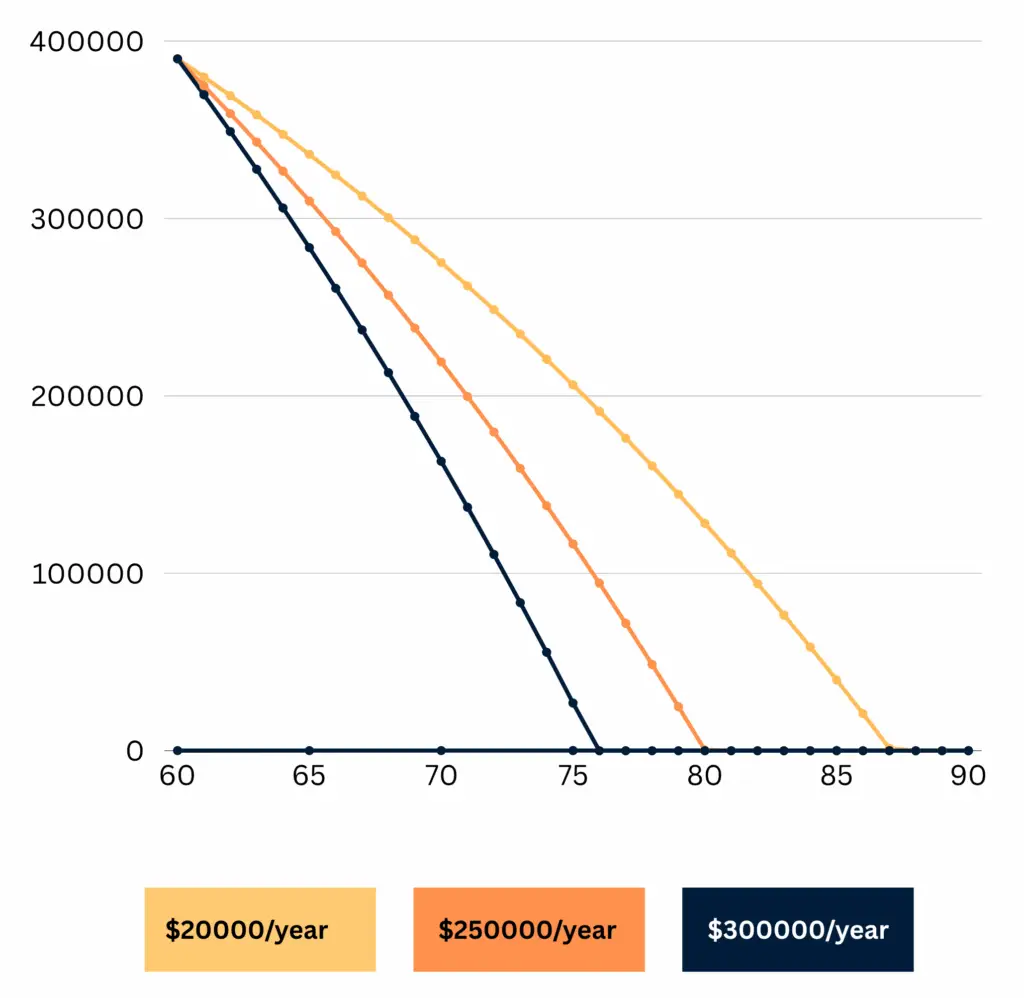
How Long Will $390,000 Last? Five Spending Levels
Assuming a 5% net annual return in a balanced account-based pension, with spending rising 2.5% a year for inflation:
| Annual spending (starting) | Approx. balance at 67 | Age Pension status at 67 | Approx. total income from 67 |
|---|---|---|---|
| $20,000/yr | ~$365,000 | Part pension (~$28,700/yr) | ~$43,000 to $47,000/yr |
| $25,000/yr | ~$319,000 | Full pension (~$31,200/yr) | ~$44,000 to $47,000/yr |
| $28,000/yr | ~$292,000 | Full pension (~$31,200/yr) | ~$43,000 to $46,000/yr |
| $31,000/yr | ~$264,000 | Full pension (~$31,200/yr) | ~$42,000 to $44,000/yr |
| $36,000/yr | ~$219,000 | Full pension (~$31,200/yr) | ~$40,000 to $42,000/yr |
The counter-intuitive finding at this balance: drawing only $20,000 a year through the bridge leaves roughly $365,000 at 67, which sits above the $333,000 full pension threshold for a single homeowner. That means a part pension of around $28,700 rather than the full $31,200. Drawing $25,000 or more brings the balance below the threshold and qualifies for the full pension. In this balance range, being more generous with yourself during the bridge years can actually improve your Age Pension entitlement at 67.
Total income from 67 converges across the whole spending range because the Age Pension compensates for lower balances. The real value of drawing conservatively isn’t the income you receive from 67. It’s the buffer you hold for healthcare, home maintenance and genuine flexibility in your 70s and 80s. Keep in mind assessable assets at 67 also include your car and contents, not just super, so the thresholds bite slightly earlier in practice.
Age Pension figures current as at August 2026 per Services Australia. These figures are set by the Australian Government: payment rates are indexed each March and September, and means test thresholds each July.
Where $390K Sits Against the Benchmarks
Average super balances for Australians aged 60 to 64 sit at approximately $396,000 for men and $313,000 for women (APRA data). At $390,000 you’re right on the national midpoint for this age group: just below the male average, comfortably above the female average.
The ASFA Retirement Standard (March quarter 2026) puts annual spending for a single homeowner at $36,434 for a modest lifestyle and $55,923 for a comfortable one. The projections above show $390K comfortably funds a modest-to-middle retirement once the Age Pension arrives, but a fully comfortable lifestyle from 60 onward would deplete the balance well before 67 territory becomes safe.
One thing the raw gap to the comfortable benchmark overstates: ASFA models retirement at 67 with the Age Pension supplementing from day one. A single homeowner retiring at 60 on $390K and drawing $28,000 a year arrives at 67 with roughly $292,000 and a full pension entitlement, for a combined income around $43,000 to $46,000. For a homeowner with no debt, that funds a stable, genuine retirement, particularly once the pensioner concession card starts cutting healthcare and utility costs.
What Changes the Picture
Couples. A couple with $390K to $499,000 in combined assessable assets at 67 qualifies for the full couple pension of around $47,000 a year (current as at August 2026), which becomes a substantial income floor on top of super drawdowns. Shared fixed costs make $390K combined stretch much further than $390K alone.
Renting. Renting changes everything. Add $20,000 or more a year in rent and $390K depletes far faster, and the single Age Pension doesn’t comfortably cover rent plus living costs in most capital cities. For renters at 60, working longer, relocating or part-time income usually needs to be part of the conversation before full retirement.
Investment settings. A common and costly pattern we see: switching everything to cash or conservative options at the moment of retirement. Scott and Phil covered this in the episode on why playing it safe can cost you more, where the same $500K balance funded retirement to the late 90s in a growth portfolio but ran out 15 years earlier in a conservative one. A 60-year-old is potentially investing for another 30 years.
Part-time work. Even $15,000 a year of part-time income through the early bridge years dramatically reduces drawdown pressure. The minimum drawdown from an account-based pension under 65 is 4%, which on $390,000 is $15,600 a year; modest work income on top of that covers a modest lifestyle while leaving most of the capital invested.
Want to see how your own spending level plays out? Run your numbers through the free Wealthlab super calculator. It takes about two minutes and models the Age Pension interaction from 67.
How the Age Pension Assessment Works at 67
From 1 July 2026, a single homeowner receives the full Age Pension with assessable assets below $333,000, with a part pension cutting out around $733,500. For homeowner couples the full pension threshold is $499,000 combined. The full single pension is around $31,200 a year and the couple rate around $47,000 combined (rates from 20 March 2026). Phil and Dan walked through real assets test and income test case studies in the episode on how the Age Pension really works, including how drawdown decisions in the final working years flow through to entitlements.
Our Age Pension guide covers eligibility, the two tests and the application process in full.
Retiring at 60 vs 61 or 62
Each additional year of work adds employer contributions, removes a year of drawdown and gives the balance another year of compound growth. On balances near this level, one extra year improves the starting retirement position by roughly $50,000 to $55,000, and we’ve broken down that comparison in detail in our post on retiring at 61 with $385K.
But the spending wave in retirement peaks in the early, active years. A bigger balance at 62 doesn’t automatically buy a better retirement than a well-planned one at 60 if the healthiest years are spent working instead. The numbers are context, not verdict. For strategies that protect the balance while retiring early, see our guide on how to retire before 67 without draining your super.
Frequently Asked Questions
Can I retire at 60 with $390,000 in super in Australia? For a single homeowner with no mortgage and spending around $25,000 to $31,000 a year, the numbers can work. $390K bridges the seven years to Age Pension age at 67, arriving with roughly $264,000 to $319,000, which qualifies for the full pension. Combined income from 67 of around $42,000 to $47,000 supports a stable retirement. Whether it suits your situation depends on individual factors.
How long will $390,000 last if I retire at 60? At $28,000 a year with 5% net returns, the balance tracks to roughly $292,000 at 67. From there the full Age Pension carries most of the load, and a modest super drawdown on top extends the balance well into the 80s. At $36,000 a year, the balance depletes much faster, but the Age Pension continues indefinitely as an income floor.
Will I get the full Age Pension at 67 if I retire at 60 with $390K? In most of the spending scenarios above, yes. Drawing $25,000 a year or more brings the balance below the $333,000 full pension threshold for a single homeowner by 67. Drawing only $20,000 a year can leave the balance above the threshold, resulting in a part pension instead. Thresholds current as at August 2026 and indexed each July.
What is the minimum I can draw from super at 60? The minimum annual drawdown from an account-based pension for someone under 65 is 4% of the balance. On $390,000 that’s $15,600 a year. There’s no maximum for a full retirement pension.
Is $390K above or below average for a 60-year-old? It’s right around the national midpoint. APRA data puts the average for ages 60 to 64 at approximately $396,000 for men and $313,000 for women.
How much do I need for a comfortable retirement instead? The ASFA comfortable standard for a single homeowner is $55,923 a year (March quarter 2026). Funding that from 60, including seven self-funded years, requires a substantially larger balance. Most people at $390K are planning for the modest-to-middle range, lifted by the Age Pension from 67.
See How Your Numbers Stack Up
The scenarios above use standard assumptions. Your actual position depends on your spending, home ownership, partner’s situation, health and returns. MoneySmart’s guide to working with a financial adviser is a useful government explainer on what advice involves and what to ask.

Book a free consultation today and discover how to make your $390K super work smarter, so you can retire at 60 with confidence and clarity.