
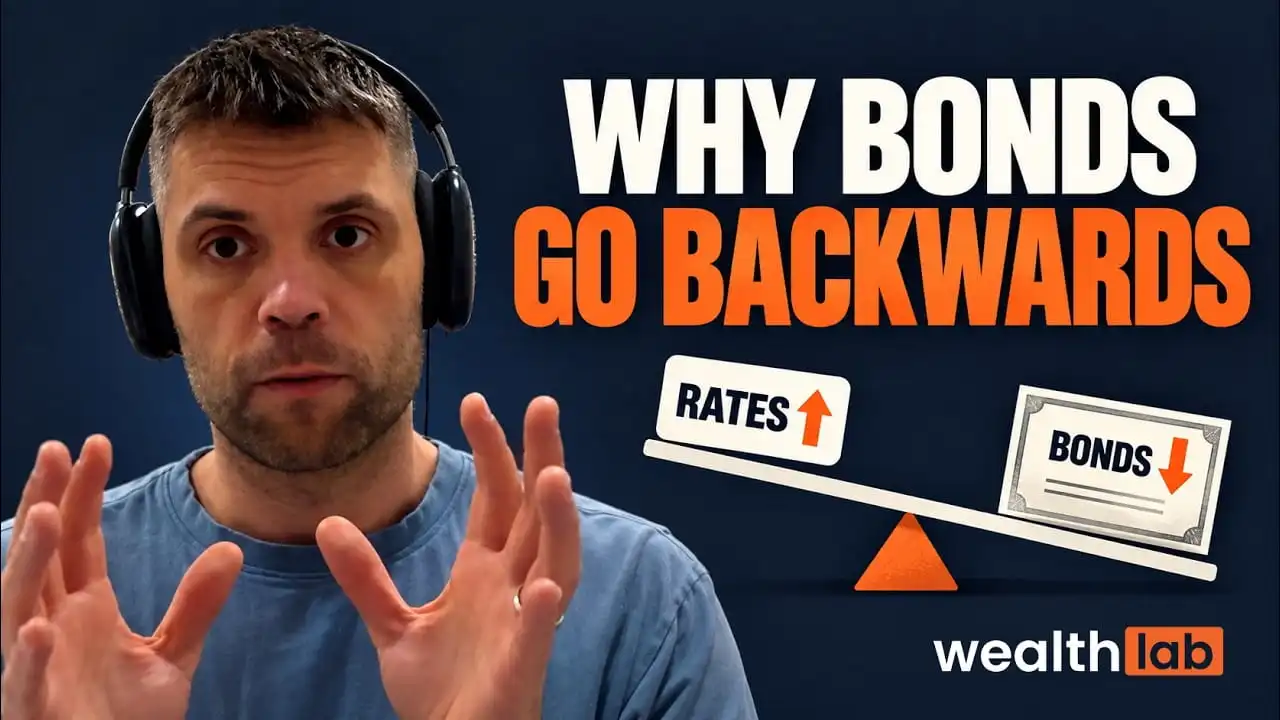
Scott opened our latest podcast episode with the observation that six years ago we were all apparently experts in virology, a few years back we were all experts in geopolitics, and now everyone’s a bond expert. Phil reckons he’s getting asked about bonds a couple of times a week.
Here’s the thing most people asking don’t realise: if you have super, you almost certainly already own bonds, probably a lot of them. So before the topic comes up at your next barbecue, it’s worth understanding what a bond actually is, why your super fund holds them, and why the “defensive” label doesn’t mean they can’t lose money. That last one catches people out.
A bond is an IOU you can buy and sell
Strip away the jargon and a bond is one of the oldest financial arrangements there is: an IOU. You lend money, and the borrower promises to pay it back on a set date, plus interest along the way. A bond is simply that IOU chopped into small, tradeable pieces.
Governments issue them to fund deficits and build things. Companies issue them to fund projects without giving up equity or accepting a bank’s terms. Banks issue them to raise the money they then lend out as home loans. Picture a toll road operator wanting to raise $2 billion: rather than hand over a slice of the business or take a restrictive bank loan, it writes thousands of IOU notes and asks the market what interest rate it wants to lend at.
The part that surprises people is that these IOUs then trade on a market, much like shares. You don’t have to hold a bond to maturity. You can sell it to someone else, and the price you get can be higher or lower than you paid.
What sets the interest rate on a bond
The rate comes down to one question: how confident is the lender of getting their money back?
The benchmark is the 10-year Australian government bond, often called the risk-free rate because the Commonwealth has the strongest claim to always paying its debts. As at October 2026 that yield has been sitting above 5%, territory last seen in 2011, after the Reserve Bank’s rate rises this year. You can check the current figure on the RBA’s capital market yields tables. From there, everything else prices off risk. A blue-chip company pays a bit more than the government. A small miner nobody has heard of pays a lot more. So-called sub-investment grade bonds can offer interest rates that look almost equity-like, and that is precisely the warning sign: the further down the credit ladder you go, the more real the chance you don’t get your money back.
Credit ratings matter for the same reason. When a state government’s rating comes under pressure, it makes the news because a downgrade means paying more interest on every new bond it issues, which feeds the very deficit it’s borrowing to cover. And issuers can set almost any terms the market will accept. Some companies overseas have even sold 100-year bonds, and found willing lenders.
Why bond prices fall when interest rates rise
Here’s the mechanics most people never get told. Say a bond is issued at a face value of $100 paying a 7% coupon. Hold it to maturity and you collect $7 a year, then your $100 back, assuming the issuer stays solvent. Simple.
Please note: All figures, examples and scenarios in this article are approximate and for illustrative purposes only. Individual outcomes will vary based on personal circumstances, market movements, fees and current government policy. This is general information, not personal advice.
But if you want to sell that bond before maturity, the price depends on what new bonds are paying. If interest rates have risen since yours was issued, nobody will pay full price for your older, lower-paying IOU, so its market value falls. Price down, yield up, and vice versa. The longer the bond has left to run (its duration), the more sensitive its price is to rate moves. A 10-year bond swings much harder than a 2-year one.
That’s why a bond-heavy “defensive” portfolio can go backwards when rates rise. Scott and Phil covered this in the 2026 market outlook episode: rising interest rates tend to hurt conservative and bond-heavy portfolios, with the damage showing up on statements with a lag of around four to six months. People in conservative options are often the most surprised to see red.

“Defensive” doesn’t mean it can’t lose money
Two real examples make the point better than theory.
The first is credit risk. In November 2019, Virgin Australia raised around $700 million through unsecured notes sold at $100 each with a $5,000 minimum, and plenty of everyday Australian investors bought in. Less than six months later, the airline was in voluntary administration. When the sale to Bain Capital completed in 2020, unsecured creditors, including roughly 6,500 bondholders, received between 9 and 13 cents in the dollar. An investment plenty of people would have filed under “safer than shares” delivered a near-total loss.
The second is correlation risk. Bonds are held because they usually move differently to shares. But in the COVID shock, equities and bonds fell together for a stretch, and funds running a lot of duration in their bond portfolios were hit hard. The diversification usually works. It is not guaranteed to work every time, particularly when inflation is the problem.
Why portfolios hold bonds anyway
Given all that, why does roughly 20% to 40% of a typical MySuper default option sit in defensive assets, much of it bonds, depending on the fund and option? Because the job of that sleeve isn’t to shoot the lights out. It’s to behave differently from shares, keep paying income through rough patches, and give the portfolio something stable to lean on. In a downturn, that income can be used to buy more shares while they’re cheap. If you’ve never looked at what’s inside your own super, the split between growth and defensive assets is the first thing worth finding.
Phil told a story on the episode that captures the whole idea. He was reviewing a portfolio line by line with a client who wanted the nuts and bolts, and a couple of lines were red, including global bonds. The client asked what Phil was doing about it. His answer: “I’m not doing anything about it. That’s what it’s supposed to do.” The bond line had fallen by a couple of thousand dollars on paper, but it had paid out around $14,000 in income over the period, and the overall portfolio had grown. If every line in a portfolio moves in the same direction at the same time, it isn’t diversified.
Scott’s summary on the episode is hard to beat: bonds in a portfolio are like the layers in a lasagna. They need to be in there. How much is a matter of taste and how the chef puts it together.
What rising bond yields mean for you
Bond markets are also worth watching because they tell you what investors expect from interest rates and the economy. A few practical readings from where things sit in late 2026:
If you hold a mortgage, rising long-term bond yields are not what you want to see. They usually signal that markets expect rates to stay higher or go higher, and banks’ fixed rates tend to move with them.
If you’re retired or close to it, higher yields cut the other way. Cash and new fixed income investments are paying their best income in well over a decade, which is genuinely good news for people living off their savings. We generally find retirees underestimate how much this environment has improved the income side of their position.
As a taxpayer, it’s why the government’s debt keeps making headlines. Australia’s gross federal debt crossed $1 trillion for the first time in August 2026, and with yields above 5%, the interest bill on that borrowing has become one of the fastest growing areas of government spending. Figures from the Australian Office of Financial Management, current as at October 2026. That’s the Queensland credit rating story and the federal deficit story rolled into one: higher yields make debt more expensive for everyone who issues it.
The full episode goes deeper on all of this, barbecue tangents included:
[INSERT YOUTUBE URL FOR THE BONDS EPISODE ON ITS OWN LINE – see implementation notes]
You can also find every episode on the Wealthlab podcast page.
Frequently asked questions
What is a bond in simple terms?
A bond is an IOU that can be bought and sold. You lend money to a government or company, they promise to repay it on a set date, and they pay you interest (called a coupon) along the way. Unlike a term deposit, a bond can be traded before it matures, and its market price moves up and down.
Why does my super fund hold bonds?
Bonds usually behave differently to shares, pay regular income, and steady a portfolio during sharemarket falls. Most MySuper default options hold somewhere between roughly 20% and 40% in defensive assets, with bonds making up a large share of that, depending on the fund and the option’s label.
Can bonds lose money?
Yes, in two main ways. If interest rates rise, the market value of existing bonds falls, which is why bond funds can show negative returns in rate-rising years. And if the issuer fails, bondholders may recover only part of their money, as Virgin Australia’s noteholders found in 2020 when unsecured creditors received between 9 and 13 cents in the dollar.
Why do bond values fall when interest rates rise?
Because nobody will pay full price for an old IOU paying 5% when new ones pay 6%. The price of the older bond drops until its return matches what the market now offers. The longer the bond has until maturity, the bigger that price move, which is what “duration” measures.
What is the 10-year government bond rate in Australia?
As at October 2026, the Australian 10-year government bond yield has been trading above 5%, its highest level since 2011. It moves daily, and the current figure is published in the Reserve Bank of Australia’s capital market yields tables. The 10-year rate matters because it acts as the benchmark that other interest rates, including fixed mortgage rates, tend to price off.
Are government bonds risk-free?
They carry the lowest credit risk in the market, because a government with a strong credit rating is highly likely to repay. But their market price still moves with interest rates, so holding them through a rate-rising period can mean paper losses, and lower-rated government issuers pay more interest for a reason.
Not sure what’s actually inside your super?
Most people can name their super fund but not what’s in it. If this has made you curious about your own mix of shares, bonds and everything else, and whether it still suits the stage you’re at, book a free chat with the Wealthlab team. No pressure, no jargon, just a plain English look at how your money is actually set up. For how all of this fits into the bigger picture, our retirement planning page is the place to start.
Prefer a quick snapshot first? The free Wealthlab retirement quiz takes about a minute.