

Yes, retiring at 60 with $620,000 in super is possible for many Australians, but it requires more careful planning than higher balances because the margin for error is smaller. At $620K you’re above the average retirement balance, but you’re also looking at potentially 25 to 30 years of retirement to fund, with no Age Pension available for the first seven of those years. Getting your spending, investment allocation and drawdown strategy right from the start matters a lot at this balance.
Here’s what the numbers actually look like and what you need to think through.
The 7-Year Pre-Pension Gap Is the First Problem to Solve
The Age Pension isn’t available until 67. If you retire at 60, your super funds everything for seven years on its own.
At a drawdown of around $45,000 to $50,000 a year for a single retiree, that’s roughly $315,000 to $350,000 out of your $620K before any government support arrives. Even accounting for investment returns on the remaining balance, this is a meaningful chunk of your starting capital. It’s the main reason that spending discipline in the first decade of retirement has such a large effect on how long your money ultimately lasts.
This is also where the FAQ answer in the original post gets it wrong: recommending a “more conservative investment strategy” at 60 sounds prudent but for a retirement that could run to age 85 or 90, being too conservative early on is one of the more common ways retirees end up running short. Scott and Phil covered this in detail in episode 1 of the Wealthlab Podcast, working through what actually happens to conservative versus growth portfolios over a 25 to 30 year retirement. It’s worth a listen if you’re making investment decisions at this stage.
What Income Does $620K Support?
The ASFA Retirement Standard gives a practical benchmark for retirement spending in Australia (as at December 2024, ASFA):
- Single: around $51,278 per year for a comfortable retirement
- Couple: around $72,148 per year
At $620K, a single retiree drawing $40,000 to $45,000 a year is in a workable position, particularly if they own their home and have no significant debt. A couple drawing $55,000 to $60,000 combined would be stretching the balance harder, but with reasonable investment returns and the Age Pension arriving at 67, it remains workable.
Owning your home outright is one of the biggest factors in how far $620K goes. Without rent or mortgage repayments, the same balance covers considerably more lifestyle.
Please note: All figures, projections and scenarios in this article are approximate and for illustrative purposes only. Individual outcomes will vary based on personal circumstances, investment returns, fees, and current government policy. This is general information, not personal advice.
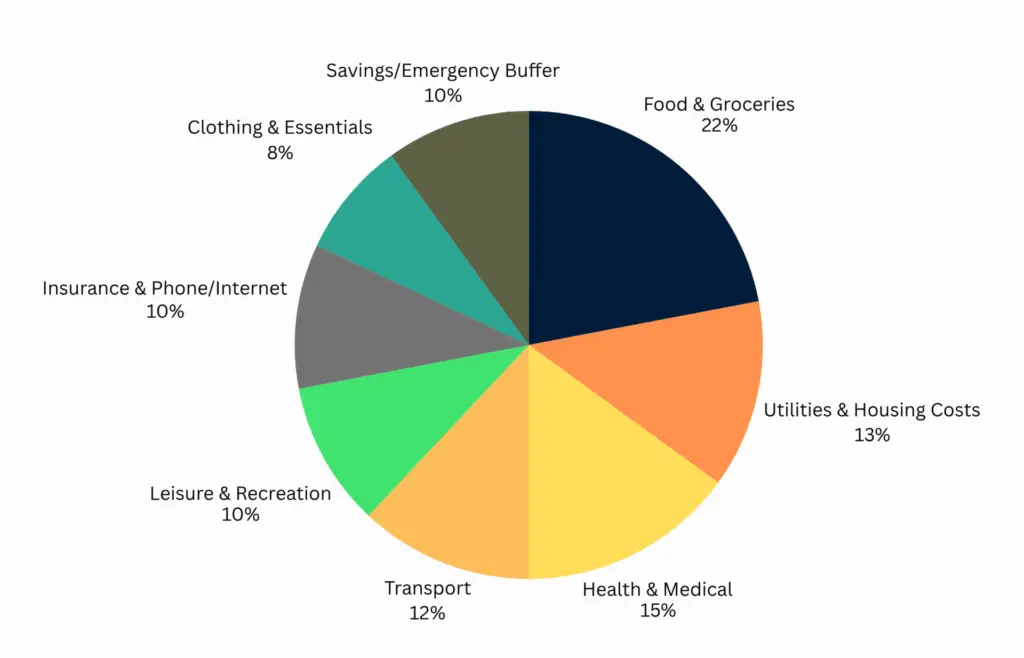
How Would You Budget $30K/Year?
If you plan a modest retirement lifestyle, here’s a breakdown of where your money might go:
| Category | % of Budget |
|---|---|
| Food & Groceries | 22% |
| Utilities & Housing Costs | 13% |
| Health & Medical | 15% |
| Transport | 12% |
| Leisure & Recreation | 10% |
| Insurance & Internet | 10% |
| Clothing & Essentials | 8% |
| Emergency/Savings Buffer | 10% |
This type of budget is realistic and can offer a fulfilling retirement if you’re careful and well-prepared.
How the Age Pension Changes the Picture at 67
Once you reach 67, the Age Pension can meaningfully extend how long your super lasts by supplementing your drawdown. The current maximum rates (as at April 2026, per Services Australia) are:
- Single: approximately $31,223 per year
- Couple (combined): approximately $47,070 per year
With $620K at 60 and seven years of drawdown before pension age, many retirees in this position find their balance has reduced enough by 67 that they qualify for at least a part pension, which then carries more of the income load and allows them to draw less from super. That dynamic, super doing the heavy lifting in your 60s and the pension progressively supplementing from 67, is the basic shape of most retirement income strategies at this balance level.
Understanding how the Age Pension assets and income tests interact with your super is genuinely valuable to get across before you retire, not after you’ve already started drawing down.
Current as at April 2026. Age Pension rates are updated by the Australian Government each March and September.
Sequencing Risk: The Risk Most People Don’t See Coming
One of the less obvious risks for anyone retiring at 60 with $620K is sequencing risk, which is what happens when your portfolio drops significantly in the early years of retirement while you’re drawing it down. Unlike an accumulation phase where you can ride out a market fall and keep contributing, a sharp fall in year two or three of retirement locks in real losses because you’re selling units at lower prices to fund your income.
This doesn’t mean avoiding growth assets. It means structuring your portfolio so you’re not forced to sell growth assets at the wrong time. Keeping one to two years of income in cash or short-term assets, while leaving the growth portion of the portfolio to recover, is a common approach. The specifics depend on individual circumstances and are worth working through with a financial adviser.
Strategies Worth Understanding at This Balance
Account-Based Pension
When you retire and shift your super into an account-based pension, earnings on that money move to a tax-free environment. That’s a step up from the 15% tax on earnings in the accumulation phase, and it’s one of the meaningful financial advantages of retiring properly. At $620K, the tax saving on earnings inside the pension phase can make a real difference to how long the balance lasts.
Transition to Retirement
If you haven’t fully stopped work yet, a transition to retirement (TTR) pension lets you access some of your super while still employed. It can help you reduce hours and top up your income from super on a tax-effective basis while still growing your balance. It’s not right for every situation, but understanding how it works before you make the decision to retire is worthwhile.
Keeping an Eye on the Assets Test
For homeowner singles, the lower assets test threshold for a part Age Pension currently sits at $314,000 (as at April 2026, Services Australia). For homeowner couples it’s $470,000. With $620K at 60 and seven years of drawdown before pension age, many retirees are positioned to move into at least partial pension eligibility by their late 60s or early 70s. The family home remains excluded from the assets test throughout.
These figures are updated by the Australian Government each March and September.
Downsizer Contributions
If you’re 55 or older and considering selling the family home before you retire, the downsizer contribution scheme allows you to contribute up to $300,000 per person ($600,000 per couple) into super from the sale proceeds. For someone approaching retirement with $620K, this could meaningfully increase the balance before the drawdown phase begins. There are conditions and timing rules that matter here, including a 90-day deadline after settlement. The Wealthlab Podcast episode on downsizer contributions walks through the traps in detail.
Want to Run Your Own Numbers?
The figures in this article are general illustrations. Your actual retirement picture depends on your specific spending, health, whether you’re single or part of a couple, your home ownership situation, and how your super is invested.
The free Wealthlab super calculator lets you plug in your own numbers and get a clearer sense of how your balance, drawdown and Age Pension might fit together over time.
FAQs: Retiring at 60 with $620K in Australia
Is $620K enough to retire at 60 in Australia?
For many Australians, particularly homeowners with modest spending, $620K is a workable starting point. The key variable is how much you plan to draw each year and how your super is invested during retirement. A single retiree drawing $40,000 to $45,000 a year from $620K, with the balance remaining invested, is in a different position to one drawing $60,000. The Age Pension from 67 also materially changes the long-term picture.
How long will $620K last in retirement?
It depends on your drawdown rate, investment returns, fees and inflation. A retiree drawing around $42,000 to $45,000 a year from $620K with reasonable returns and Age Pension support from 67 could fund retirement well into their mid to late 80s. Higher spending without adjustment shortens that significantly.
Should I use a conservative investment strategy at 60?
Not necessarily. A 60-year-old retiring today may have 25 to 30 years ahead of them. An overly conservative portfolio in the early years can lose ground to inflation and reduce how long the money lasts. Most financial planners would suggest maintaining meaningful growth exposure even in retirement, with a cash buffer to manage short-term income needs and avoid selling growth assets at the wrong time. Individual circumstances vary and it’s worth getting specific advice on this.
Can I access my super at 60?
Yes. Australia’s preservation age is 60 for anyone born after 30 June 1964. You can access your super at 60 provided you’ve met a condition of release, such as retiring or ceasing an employment arrangement. This is separate from the Age Pension, which isn’t available until 67. The Wealthlab Podcast episode on preservation age covers the conditions of release clearly.
Will I qualify for the Age Pension with $620K in super?
Likely not at 67 if your balance is still close to $620K, as that may sit above the full pension assets test threshold depending on your other assets. However, as your balance draws down through your 60s, many retirees in this position transition into at least partial pension eligibility over time. The family home is excluded from the assets test, which is a significant factor for homeowners.
What is the biggest risk of retiring at 60 with $620K?
The two biggest risks are spending too much in the early years, which permanently reduces the capital base, and being too conservative with the investment allocation, which lets inflation quietly erode purchasing power over a long retirement. Getting the balance between these two right is what a good retirement income strategy is designed to do.
$620K at 60 is a meaningful balance and a genuine foundation for retirement for many Australians, particularly those who own their home. The planning challenge at this balance is tighter than at higher figures because you’re relying on investment returns and eventual Age Pension support to carry more of the load. Getting the drawdown rate, investment allocation and Age Pension timing right from the start makes a real difference to how the next 25 to 30 years unfold.
Take a look at how Wealthlab approaches retirement planning, or if you’re ready to talk through your own situation, book a free chat with the team.