

Retiring at 62 with $440,000 in super comes down to one stretch of time: the five years between 62 and Age Pension eligibility at 67. During that window, every dollar of spending comes from your own balance. Get through it with enough left over and the Age Pension does a surprising amount of heavy lifting from 67 onwards.
For a single homeowner, $440,000 sits in an interesting position. It is below the ASFA comfortable benchmark of $630,000, but after five years of sensible drawdown it lands close to the point where the assets test pays most of the full Age Pension. For a couple on $440,000 combined, the bridge years are much tighter. This guide walks through the actual numbers for both, using the thresholds that apply from 1 July 2026.
The 62-to-67 Bridge: What $440K Has to Cover
Super is accessible from 62 for anyone who has retired, since preservation age is 60 for everyone born after 30 June 1964. The Age Pension starts at 67. That leaves five years where your balance is the only income unless you keep some part-time work going.
The size of the drawdown over those five years is what shapes everything after. Spend $35,000 a year and roughly $175,000 leaves the account before any government support arrives. Spend $45,000 and it is $225,000. On a $440,000 starting balance, that difference decides whether you arrive at 67 comfortable or stretched.
Year by Year: $440K From 62 to 67
The table below models a single homeowner retiring at 62 with $440,000, moved into an account-based pension (where investment earnings are tax free), drawing $40,000 a year, and earning a net 5% return after fees. Real returns will not arrive this smoothly, but it shows the shape of the journey.
| Age | Balance at start of year | Drawdown | Approximate balance at end of year |
|---|---|---|---|
| 62 | $440,000 | $40,000 | $422,000 |
| 63 | $422,000 | $40,000 | $403,100 |
| 64 | $403,100 | $40,000 | $383,255 |
| 65 | $383,255 | $40,000 | $362,418 |
| 66 | $362,418 | $40,000 | $340,539 |
Please note: All figures, projections and scenarios in this article are approximate and for illustrative purposes only. Individual outcomes will vary based on personal circumstances, investment returns, fees and current government policy. This is general information, not personal advice.
So a $40,000 a year lifestyle through the bridge leaves roughly $340,000 at 67. At $35,000 a year the balance at 67 is closer to $368,000, and at $45,000 it is around $313,000. Those numbers matter enormously, because of what happens next.
What the Age Pension Adds at 67
From 1 July 2026, a single homeowner qualifies for the full Age Pension with assessable assets under $333,000, and a part pension up to $733,500. Above the lower threshold, the pension reduces by $3 per fortnight for every $1,000 of assets. The full single rate is $1,200.90 per fortnight, about $31,200 a year.
Current as at July 2026. These figures are set by the Australian Government and are typically reviewed each March, July and September. Source: Services Australia, assets test for Age Pension.
Here is where $440,000 at 62 turns out to be better positioned than most people expect. Take the three drawdown paths above, add around $25,000 for a car and household contents (which Centrelink counts), and the estimated pension at 67 looks like this:
| Spending 62 to 67 | Approx. assets at 67 | Estimated Age Pension from 67 |
|---|---|---|
| $35,000 a year | ~$393,000 | ~$26,500 a year |
| $40,000 a year | ~$366,000 | ~$28,700 a year |
| $45,000 a year | ~$338,000 | ~$30,800 a year |
In every scenario, the pension covers most of the spending from 67 onwards. In the $40,000 case, the retiree only needs to draw around $11,000 a year from super once the pension starts, which is less than the investment return the remaining balance generates in a typical year. In our modelling, the balance holds up rather than running down.
We generally find this is the single biggest blind spot for people weighing up retirement at 62. They model their super running out and stop there. The question that actually matters is what the combined income from super and the Age Pension looks like at each stage, because for balances in this range the pension ends up doing most of the work after 67.
Want to see how your own numbers track? The free Wealthlab super calculator shows how your balance, spending and the Age Pension fit together in about two minutes.
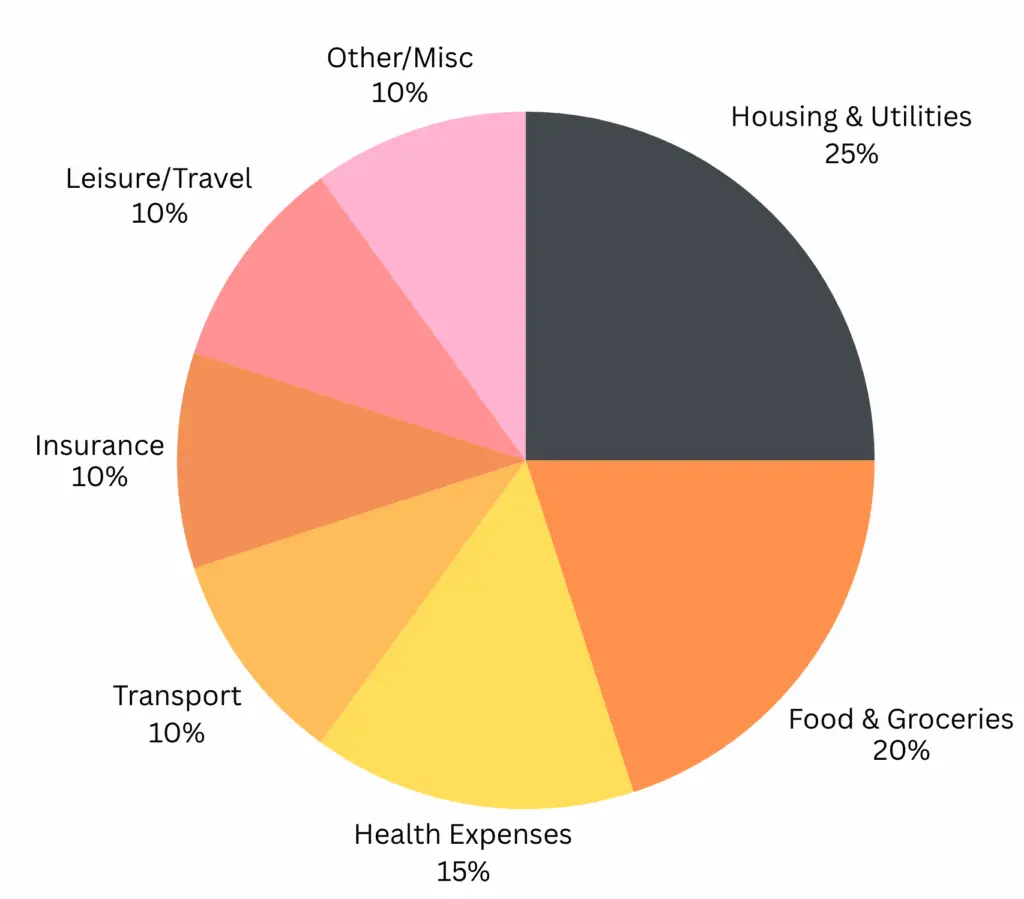
Can I Retire at 62? Budget Breakdown for $25,000 Per Year
A practical $25,000 annual budget might look like this:
| Category | Percentage of budget |
|---|---|
| Housing and utilities | 25% |
| Food and groceries | 20% |
| Healthcare | 15% |
| Transport | 10% |
| Insurance | 10% |
| Leisure and travel | 10% |
| Miscellaneous | 10% |
Can I Retire at 62? Home Ownership Advantage
Owning your home can make a significant difference. Without rent or mortgage payments, your super stretches much further. Mortgage-free retirees can combine super with part-time work or Age Pension support to maintain a stable and fulfilling lifestyle.
If you rent, consider downsizing or relocating to reduce expenses, which can help your super last longer.
The One-Year Difference Nobody Models
Scott and Phil dug into exactly this trade-off on the podcast. The average Australian couple retires with around $540,000 combined against ASFA’s comfortable benchmark, a gap of roughly $150,000 that most people never close. And the timing effect is brutal: in the scenario they walked through, retiring just one year earlier turned a plan funded to age 105 into one that ran out at 79.
For someone at $440,000 considering 62, one more year of work adds employer contributions, a full year of investment returns on the existing balance and removes a year of drawdown. On the assumptions above, that is roughly $60,000 to $70,000 of improvement in the balance at retirement. As Scott put it on that episode, “Having more money at retirement than less is less of a problem.” Whether the extra year is worth it against health, energy and the active years of retirement is a personal call, not a spreadsheet one.
What About a Couple With $440K Combined?
A couple retiring at 62 on $440,000 combined faces a harder bridge. ASFA’s modest standard for a couple is $52,473 a year and comfortable is $78,566 (ASFA Retirement Standard, March quarter 2026, homeowners). Drawing even the modest figure pulls roughly $260,000 out of the balance before 67.
The consolation is on the other side. A couple arriving at 67 with around $275,000 in super sits well under the $499,000 combined full pension threshold for homeowners, so the full couple pension of about $47,000 a year kicks in. From there, the modest lifestyle is largely pension funded and the remaining super tops it up.
In practice, we generally find couples in this position land on one of two approaches: one partner keeps part-time work going for two or three years to soften the bridge, or the couple accepts a leaner 62-to-67 and plans around the pension floor from 67. Both can work. Retiring at 62 on $440,000 combined and spending at the comfortable standard through the bridge generally does not.
Three Things That Improve the Outcome
Part-time income through the bridge. Even $15,000 a year of casual or consulting work between 62 and 67 reduces the drawdown dramatically. Over five years that is $75,000 that stays invested, which flows straight through to a stronger position at 67.
Staying invested rather than going to cash. A 62-year-old’s money may need to last 30 years. On the podcast episode about playing it safe, Scott and Phil walked through a couple with $500,000 spending $75,000 a year: a growth portfolio funded retirement into their late 90s while a conservative one ran out 15 years earlier. We generally find a middle path works for most retirees, with one to two years of spending held in cash or defensive assets and the rest in a balanced or growth option.
Understanding the assets test before retiring, not after. Small structural decisions, like which assets to draw first or how super is split between partners, can shift the pension entitlement at 67 by thousands of dollars a year. Our pension and Centrelink advice page covers how this works, and the guide on how to retire before 67 in Australia goes deeper on bridge-period strategy.
FAQs
Can I retire at 62 with $440K in super in Australia?
It depends mainly on home ownership, whether the balance is for a single or a couple, and spending. A single homeowner drawing $35,000 to $40,000 a year has a workable foundation, particularly because the Age Pension covers most spending from 67. A couple on $440,000 combined faces a tighter five-year bridge and often needs part-time income or reduced spending through it.
How long will $440,000 last if I retire at 62?
Without any Age Pension, $440,000 drawn at $40,000 a year with a 5% net return lasts roughly 17 years. With the pension from 67, the picture changes completely: in our illustrative modelling, a single homeowner drawing $40,000 a year receives around $28,700 a year in pension from 67 and only needs a small super top-up, so the balance can remain sustainable well into the 90s. Individual outcomes vary with returns, spending and policy.
Will I get the Age Pension at 67 if I retire at 62 with $440K?
Very likely, for a homeowner. From 1 July 2026 a single homeowner receives a full pension below $333,000 in assessable assets and a part pension up to $733,500. After five years of drawdown from $440,000, most single homeowners land in the range that qualifies for most of the full pension. Couples with $440,000 combined typically qualify for the full couple pension by 67.
How much does the Age Pension pay in 2026?
The full rate is $1,200.90 per fortnight for a single (about $31,200 a year) and $1,810.40 per fortnight for a couple combined (about $47,000 a year), current as at the 20 March 2026 indexation. Rates are reviewed each March and September. Source: Services Australia.
Is $440,000 below the ASFA comfortable standard?
Yes. ASFA’s lump sum benchmark for a comfortable retirement at 67 is $630,000 for a single homeowner and $730,000 for a couple. But those benchmarks assume retirement at 67, not 62, and they target the comfortable spending level of $55,923 a year for a single (March quarter 2026). Many Australians retire well below the benchmark and live comfortably by combining a smaller drawdown with the Age Pension.
Should I work one or two more years instead of retiring at 62?
Financially, each extra year typically improves the balance at retirement by $60,000 to $70,000 on a $440,000 starting point through contributions, returns and avoided drawdown. Whether that outweighs the value of extra healthy, active retirement years is a personal decision that the numbers can inform but not answer.
Where You Actually Stand
The scenarios above show the shape of a $440,000 retirement at 62, but the details that decide it, your spending, your partner’s position, your home and how your super is invested, are specific to you.lone: how your super is invested, how you structure drawdowns, when you apply for the Age Pension, and whether your spending plan reflects how you’ll actually live.
At Wealthlab, we work through exactly these scenarios with people approaching retirement. If you’d like to understand what retiring at 62 could look like with your specific numbers, book a free chat with the team. No jargon, no pressure,or take the free Wealthlab retirement quiz .