
The negative gearing and capital gains tax changes announced in the May 2026 budget are now law, and if your inbox has been a panic-merchant playground since budget night, this is the calmer version. The short answer: if you owned your investment property before 7:30pm on 12 May 2026, your negative gearing treatment is grandfathered until you sell. The bigger changes start on 1 July 2027, and they mostly affect properties bought after budget night and gains that accrue after the new rules commence.
A lot of what’s flying around social media is either wrong or wildly out of context. The “47% of my business” memes, the “death tax” hot takes, all of it. So let’s call the thing the thing.
What the negative gearing change actually says
From 1 July 2027, net rental losses on established residential properties purchased after 7:30pm AEST on 12 May 2026 can no longer be offset against salary or other income. Those losses are quarantined: they carry forward and can only be applied against future residential property income or residential capital gains.
Three big carve-outs soften it. Properties owned, or under contract, before budget night are grandfathered, keeping the current treatment for as long as you hold them. Newly built residential dwellings are excluded, so they can still be negatively geared. And investments held inside superannuation are unaffected entirely.
What the CGT change actually says
From 1 July 2027, the 50% CGT discount for individuals, trusts and partnerships is replaced. Instead, the cost base of assets held longer than 12 months is indexed for inflation, so only the real gain is taxed, and a 30% minimum tax rate applies to that remaining real gain.
Two details the headlines skip. The 30% is a minimum, not a flat rate: it only tops up tax on the post-1 July 2027 portion of a gain where your effective rate on it would otherwise be below 30%. Someone already paying 30% or more on the gain pays no extra. And gains accrued before 1 July 2027 are assessed under the current rules, so the new framework only applies to the slice of growth that happens after the transition.
Companies and super funds keep their existing CGT treatment, including the one-third discount in accumulation phase and the CGT exemption in pension phase. Owners of new dwellings and affordable housing can choose between the old 50% discount and the new framework.
Legislative details are current as at September 2026, per the Treasury Laws Amendment (Tax Reform No. 1) Act 2026, with commencement 1 July 2027. The finer mechanics, including how quarantined losses interact with the new CGT method statements, are genuinely complex, so speak to your accountant about how they apply to your numbers.
The maths gap Phil found
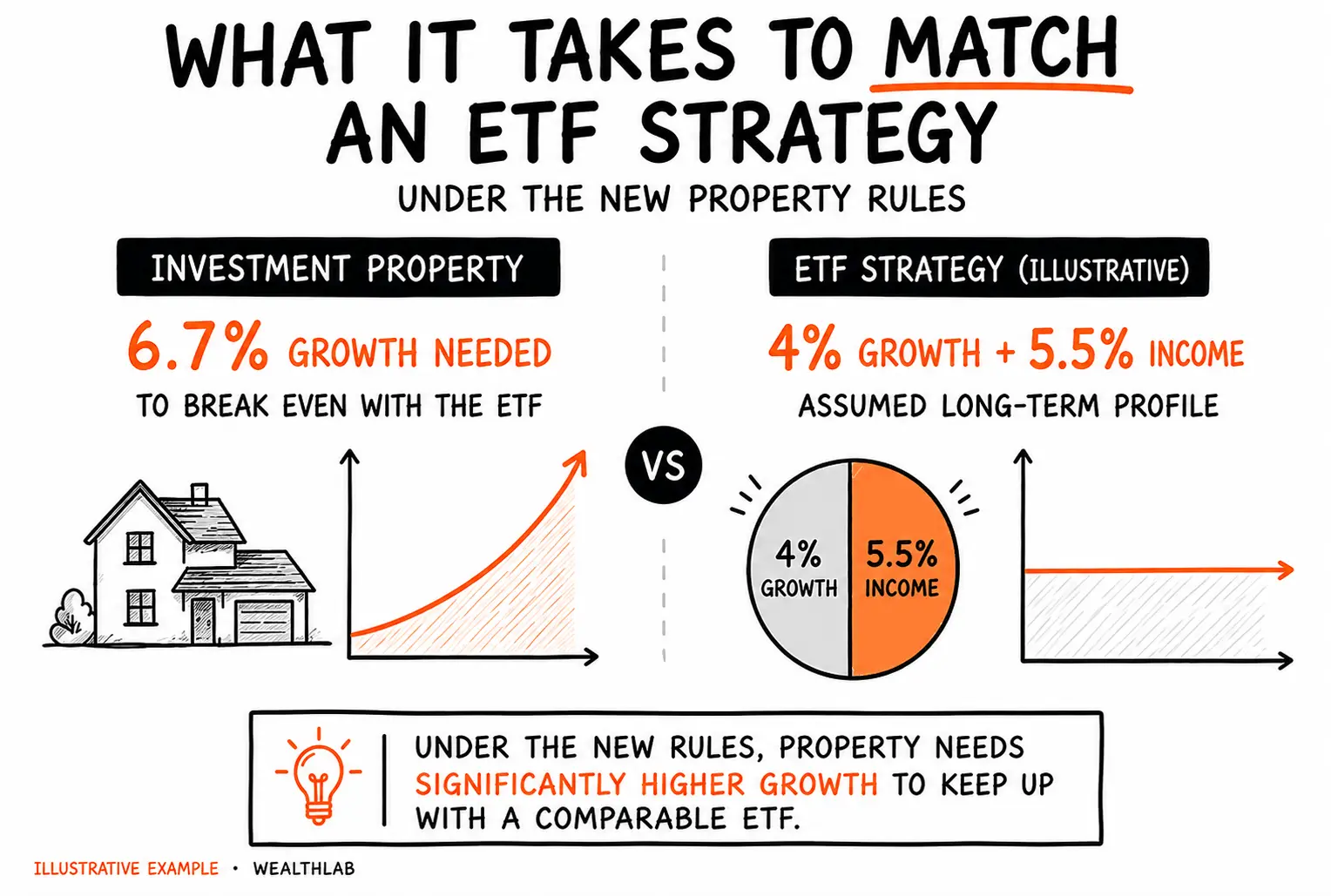
On the podcast, Phil ran a comparison that cuts through the noise: what does an investment property now need to do to match a simple ETF strategy under the new rules?
On his illustrative assumptions, an ETF portfolio with a long-term profile of around 4% growth plus 5.5% income sets the benchmark. For an established investment property bought under the new rules to break even with that, it needs roughly 6.7% annual growth. That gap is the whole story.
Please note: All figures, projections and scenarios in this article are approximate and for illustrative purposes only. Individual outcomes will vary based on personal circumstances, investment returns, fees, tax position and current government policy. Past performance is not a reliable indicator of future results. This is general information, not personal advice.
Property still works for plenty of people. It just needs more growth to do the same job, which means more due diligence than ever on yield, location and your own holding period. As a reality check from the same episode: Sydney residential rental yields were sitting around 2.5% as at May 2026 (SQM Research and market reporting), roughly half what a term deposit was paying at the time, and the term deposit doesn’t come with tenants, repairs or landlord insurance. Property has to earn its place through growth.
There’s another wrinkle from the episode worth knowing: banks moved before the law did. Phil was hearing from brokers within weeks of budget night that some lenders had stopped counting negative gearing in their serviceability calculations, and a few buyers lost deposits when pre-approvals stopped stacking up. Borrowing capacity is part of the new maths too.
Why this matters more once you’re 50+
For a lot of our clients, the investment property was the plan. Second-biggest asset after super, sometimes the first. The cash flow shapes the retirement budget, and the eventual sale funds the lifestyle. Now the rules underneath all of that have genuinely moved, not just been rumoured to.
In our view, that isn’t a reason to panic-sell. It’s a reason to re-do the maths. Where does the property sit in your overall plan? Does the eventual sale still get you where you want to go?
A few questions worth checking before making any move: What’s the current yield on the property, meaning rent minus all costs? How much does the overall position rely on the negative gearing offset against wages, and is the property grandfathered? What was the originally planned holding period, and is it still on track? And for anyone with a family trust, what do the separate trust tax changes mean for distributions? That last one is squarely accountant territory.
We generally find that if two or more of those questions draw a blank, a conversation before any decision saves a lot of undoing later.
Timing a property sale around retirement was already a big lever before these changes. Phil walked through a real case study in our episode on how the Age Pension really works: selling an investment property in the client’s last working year meant a $98,000 CGT bill, delaying to the first retirement year dropped it to $73,000, and adding catch-up contributions brought it down to $11,000. The new rules add another layer to that timing question from 1 July 2027, which is exactly why the maths deserves a fresh look rather than a fast decision.
Lifestyle first, wealth second, tax third
There’s a thread running through the property rules, the rate moves and the budget noise: the temptation to treat every news cycle as something requiring an immediate move. Sell the property. Switch the strategy. Reshuffle the portfolio. Tax planning becomes the tail wagging the dog.
We’d push back gently on that. Big decisions, especially around property, tend to work out best when they’re made on the basis of where you actually want to be in 10 or 15 years. Lifestyle planning first, wealth planning second, tax planning third. A rule change shuffles the third one. It doesn’t get to rewrite the first two. That’s the core of how we approach retirement planning at Wealthlab.
Scott and Phil work through the whole package on the podcast, including what the proposals actually say versus what your barbecue mate is telling you, and the CGT detail almost no one is talking about. Find the episode on the Wealthlab podcast page. And if you want to see how your property, super and Age Pension fit together in one picture, run your numbers through the free Wealthlab super calculator.
FAQ
Can I still negatively gear my investment property? If you owned the property, or had it under contract, before 7:30pm on 12 May 2026, yes. Grandfathered properties keep the current negative gearing treatment for as long as you hold them. Newly built residential dwellings can also still be negatively geared. The quarantining rules apply to established properties bought after budget night, from 1 July 2027.
What replaced the 50% CGT discount? From 1 July 2027, individuals, trusts and partnerships index the cost base of assets held over 12 months for inflation, so only real gains are taxed, and a 30% minimum tax rate applies to the post-commencement portion of the gain. Gains accrued before 1 July 2027 are assessed under the old rules.
Is the 30% minimum tax rate a flat tax on capital gains? No. It’s a top-up that only applies where your effective tax rate on the post-1 July 2027 indexed portion of a gain would otherwise be below 30%. Anyone already paying 30% or more on that portion pays nothing extra.
Do the CGT and negative gearing changes affect super? No. Superannuation funds keep their existing CGT treatment, including the one-third discount in accumulation phase and the CGT exemption in pension phase, and the negative gearing changes don’t touch investments held inside super.
Should I sell my investment property before the rules change? That depends entirely on individual circumstances, which is why it’s a question for personal advice rather than a blog post. Grandfathering, the timing of accrued gains, retirement timing and Age Pension effects all interact. Many investors find that re-running the numbers with an adviser and accountant beats reacting to headlines.
When do the negative gearing and CGT changes start? Both commence on 1 July 2027. The negative gearing quarantining applies to established residential properties purchased after 7:30pm AEST on 12 May 2026, and the new CGT framework applies to gains accruing after commencement.
Was the investment property your retirement plan?
If these changes have you wondering whether the plan still gets you where you want to go, book a free chat with the Wealthlab team. Whether it’s “do I need to do something about this property?” or “I’m just not sure what to think”, we’d rather have the conversation than have you sit on it. Or start with the free Wealthlab retirement quiz for a general snapshot.