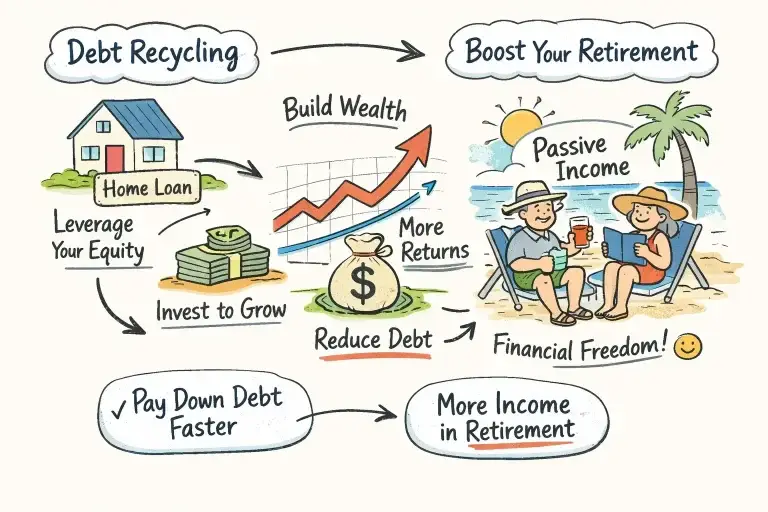
How Debt Recycling Can Supercharge Your Retirement Income
Debt recycling is a strategy that converts non-deductible mortgage debt

Debt recycling is a strategy that converts non-deductible mortgage debt

The same dollar loses up to 47 cents as salary or 15 cents inside super. That gap is the whole deal. The 2026-27 caps and rules explained, plus the case study where timing and catch-up contributions turned a $98,000 CGT bill into $11,000.

What Are the Biggest Regrets in Retirement? Understand common retirement regrets around money, health, and lifestyle, and how to plan a better retirement in Australia.

What’s the average super balance at 60 in Australia? Learn how it compares to $600K super, whether it’s enough to retire, and how superannuation and the Age Pension work together in retirement.

How do I apply for the Age Pension in Australia? Learn who’s eligible, when to apply, what documents you need, and how to submit your claim through Centrelink.

how do couples adjust after retirement?
The short answer is with communication, flexibility, and a willingness to redefine roles, routines, and expectations.

How much super should I have at 50 in Australia? The average is around $212,000, but ASFA benchmarks suggest $280,000 to $370,000 for a comfortable retirement. See where you stand and how to catch up if you’re behind.

Planning for retirement? Discover the 10 essential steps to take before you retire and master your retirement strategy. From financial planning to lifestyle adjustments, this guide helps you secure a confident and stress-free retirement.

How long will $700,000 last in retirement in Australia? At $40K to $50K a year, $700K can stretch 17 to 25 years from super alone, and longer with Age Pension support. See year by year projections and how to make your super last.

Can retirement cause depression? Learn why some Australians struggle with post-retirement emotions, what signs to watch for, and how to build a happier, purpose-driven retirement.

Thinking about retirement? Here’s how to know if you’re truly ready financially and emotionally. Discover the 7 key signs you’re prepared for life after work.

The short answer? For most homeowners, yes, and with more room than the headlines suggest. On reasonable assumptions, a homeowning couple retiring at 67 with $1 million can spend at ASFA’s full comfortable standard of $78,998 a year and see the money last to around age 100. A single homeowner at the comfortable standard of $56,166 a year holds up even longer. Renters, early retirees and anyone planning a $100,000-a-year lifestyle face a harder equation, which we cover below.

Yes, you can retire at 55 in Australia. There is no law that prevents you from stopping work at any age. The challenge is that for most Australians (anyone born after 30 June 1964), you cannot access your superannuation until age 60, and the Age Pension does not begin until 67.
Retiring at 55 creates two income gaps you must fund independently: a 5-year gap before super access, and a 7-year gap before pension eligibility.
Most Australians who retire successfully at 55 need a total of $1.2 to $1.8 million in combined assets across super and non-super savings, depending on lifestyle, home ownership, and spending targets.
The specific number depends on how the money is structured across the three retirement phases: the gap years (55 to 59), super access (60 to 66), and pension-supported retirement (67 and beyond).
This guide covers when you can actually access your super, how much super is generally required to retire at 55, how to fund the gap years, and how to build a three-phase plan that lasts 35 or more years.

Can my children inherit my super? Learn how superannuation inheritance works in Australia, who qualifies, how it’s taxed, and how to ensure your children receive it properly.

Should I keep investing after retirement? Learn why continuing to invest can help your money last longer, beat inflation, and support a comfortable retirement.

This month’s newsletter is a trip down memory lane. We’ve dug out some old photos and reflecting on what we’ve picked up along the way.

Welcome to 2025! New year, same goal—helping you stay on top of your finances without all the noise. But aahh is it too late to