

How long will $700K last in retirement? If you’re asking that question, you’re already thinking about retirement the right way. The short answer is that $700,000 in superannuation can last anywhere from 15 years to well over 30, depending on how much you spend, how your money is invested, and when the Age Pension starts supporting you.
$700K puts you above the ASFA comfortable retirement standard for singles ($630,000) and close to the couples benchmark ($730,000), both updated February 2026. So you’re not starting from a weak position. But making it last requires a plan, not guesswork.
Please note: All figures, projections and scenarios in this article are approximate and for illustrative purposes only. They assume a conservative real return of approximately 2.4% after inflation (typical for a balanced retirement portfolio). Individual outcomes will vary based on personal circumstances, investment returns, fees and current government policy. This is general information, not personal advice.
How long will $700,000 last in retirement at different spending levels?
How long $700K lasts comes down to one thing more than any other: your annual spending.At $30,000 a year, $700K could last around 28 to 30 years. At $40,000 a year, you’re looking at roughly 22 to 25 years. At $50,000 a year, the money lasts closer to 17 to 20 years. And at $60,000, expect roughly 14 to 16 years.
Those figures assume you’re drawing from super alone with no other income. Once the Age Pension kicks in at 67, your super drawdown drops, which can add five or more years to those timeframes.
That’s why how long $700K lasts in retirement is never a single number. It’s a range, and the plan you put around it determines where you land.
What $700,000 in superannuation really means for your retirement
$700,000 in superannuation puts you ahead of most Australians heading into retirement. The average super balance for men aged 60 to 64 is approximately $381,000 and for women approximately $301,000, based on ASFA’s analysis of ATO data. So at $700K, whether that’s your individual balance or combined with a partner, you’ve got more to work with than the majority.
For a single person, $700K is above the ASFA comfortable retirement standard. That means a lifestyle that includes private health insurance, regular social activities, domestic holidays, eating out occasionally and an overseas trip every few years is realistic. ASFA estimates comfortable spending at $54,840 a year for singles (spending figures updated quarterly).
For a couple with $700K combined, you’re just under the $730,000 ASFA comfortable benchmark. That’s close enough that with Age Pension support from 67 and controlled spending, a comfortable retirement is well within reach. ASFA estimates couples need $77,375 a year for a comfortable lifestyle.
The important thing to understand is that $700K doesn’t guarantee a good outcome on its own. What makes the difference is how you draw it down, how it’s invested, and how it works alongside the Age Pension.
Scott talked about why fixating on the balance number instead of the income plan is one of the most common mistakes in Episode 8 of the podcast. The goal isn’t to die with the largest super balance possible. It’s to convert capital into confident living.
Is $700,000 in super enough to retire?
For many Australians, yes. If you own your home and can keep spending between $40,000 and $50,000 a year, $700,000 in super is enough to fund a comfortable retirement, particularly once Age Pension payments begin at 67.
If you’re renting, still carrying a mortgage, or planning to spend $60,000 plus a year, $700K comes under more pressure. It can still work, but it means tighter budgeting, a more disciplined investment approach, or potentially some part-time income in the early years.
Whether $700K is enough depends on three things: home ownership (which removes $20,000 to $25,000 a year in housing costs), when you retire (60 means a seven-year gap; 65 means only two), and how your money is invested (balanced vs conservative makes a 15-year difference over a 25-year retirement).
Want to see how your own numbers play ouHow long will $700K last in retirement? If you’re asking that question, you’re already thinking about retirement the right way. The short answer is that $700,000 in superannuation can last anywhere from 17 years to well beyond 30, depending on how much you spend, how your money is invested, and when the Age Pension starts supporting you. At moderate spending, the pension does not just extend the money. It can effectively stop the clock.
$700K puts you above the ASFA comfortable retirement standard lump sum for singles ($630,000) and close to the couples benchmark ($730,000), both updated February 2026. So you’re not starting from a weak position. But making it last requires a plan, not guesswork.
Please note: All figures, projections and scenarios in this article are approximate and for illustrative purposes only. They assume a real return of approximately 2.4% after inflation (typical for a balanced retirement portfolio) and current government settings. Individual outcomes will vary based on personal circumstances, investment returns, fees and policy changes. This is general information, not personal advice.
How long will $700,000 last at different spending levels?
How long $700K lasts comes down to one thing more than any other: your annual spending. At $30,000 a year, $700K alone could last beyond 30 years. At $40,000 a year, you’re looking at roughly 23 to 25 years. At $50,000 a year, the money lasts closer to 17 to 19 years. And at $60,000, expect roughly 13 to 15 years.
Those figures assume you’re drawing from super alone with no other income. Once the Age Pension starts at 67, the picture changes more than most people expect: at $40,000 to $45,000 a year of spending, a single homeowner’s $700K effectively does not run out, because the pension grows as the balance falls and takes over most of the income load. Even at $50,000 a year, the combination runs to the late 90s.
That’s why how long $700K lasts in retirement is never a single number. It’s a range, and the plan you put around it determines where you land.
What $700,000 in superannuation really means
$700,000 in superannuation puts you ahead of most Australians heading into retirement. The average super balance for Australians aged 60 to 64 is $413,700 for men and $327,440 for women, with medians around $236,000 and $175,000 (ATO Taxation Statistics 2023-24, released June 2026). So at $700K, whether that’s your individual balance or combined with a partner, you’ve got more to work with than the majority.
For a single person, $700K is above the ASFA comfortable lump sum. That means a lifestyle that includes private health insurance, regular social activities, domestic holidays, eating out occasionally and an overseas trip every few years is realistic. ASFA prices comfortable spending at $56,166 a year for singles (June quarter 2026, updated quarterly).
For a couple with $700K combined, you’re just under the $730,000 ASFA comfortable lump sum. That’s close enough that with Age Pension support from 67 and controlled spending, a comfortable retirement is within reach for many. ASFA prices the comfortable couple lifestyle at $78,998 a year.
The important thing to understand is that $700K doesn’t guarantee a good outcome on its own. What makes the difference is how you draw it down, how it’s invested, and how it works alongside the Age Pension. Scott talked about why fixating on the balance number instead of the income plan is one of the most common mistakes in Episode 8 of the podcast. The goal isn’t to die with the largest super balance possible. It’s to convert capital into confident living.
Is $700,000 in super enough to retire?
For many Australians, yes. If you own your home and can keep spending between $40,000 and $50,000 a year, $700,000 in super can fund a comfortable retirement, particularly once Age Pension payments begin at 67.
If you’re renting, still carrying a mortgage, or planning to spend $60,000 plus a year, $700K comes under more pressure. It can still work, but it means tighter budgeting, a more disciplined investment approach, or potentially some part-time income in the early years.
Whether $700K is enough depends on three things: home ownership (which removes $20,000 to $25,000 a year in housing costs), when you retire (60 means a seven-year gap; 65 means only two), and how your money is invested (balanced versus conservative makes a 15-year difference over a 25-year retirement).
This Line chart showing how $700K depletes over time under three different annual spending levels ($30K, $40K, $50K)
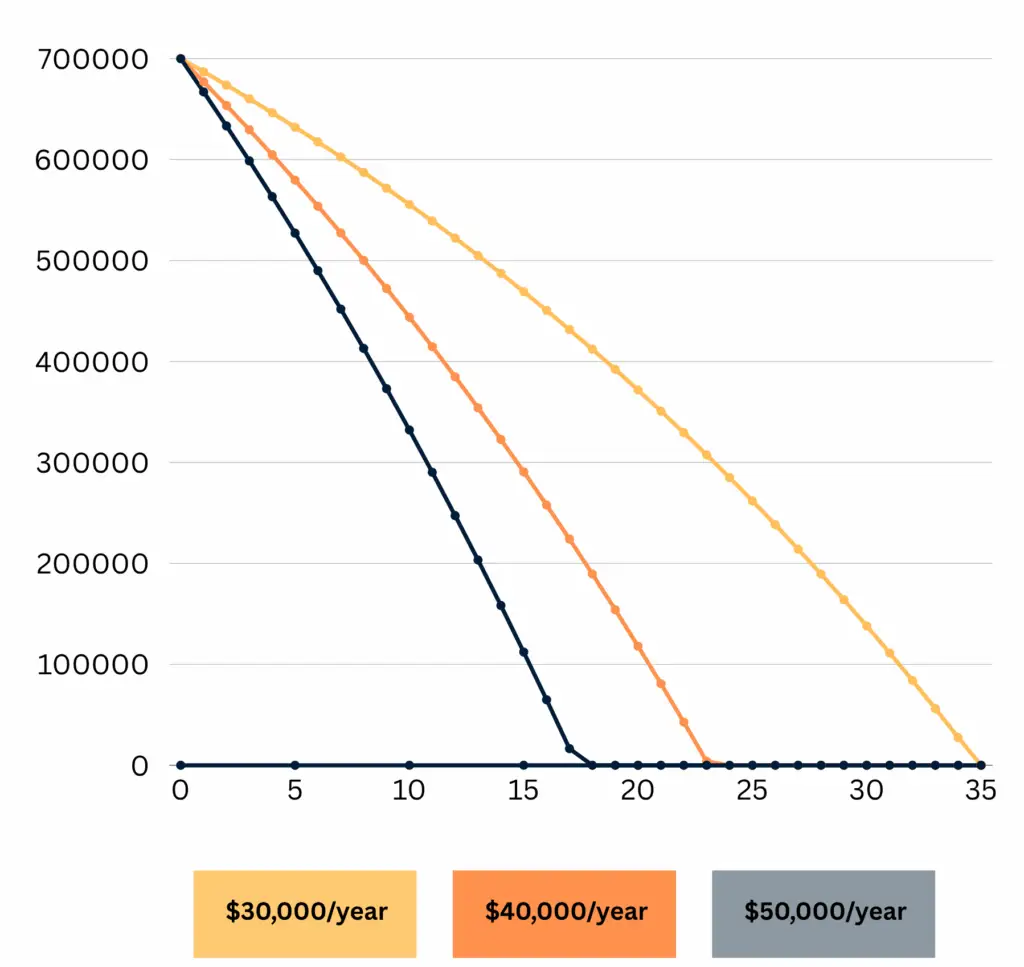
How long will $700K last from age 60 to the Age Pension?
If you retire at 60, you’ve got seven years to fund before the Age Pension starts at 67. This gap is where your plan matters most, because these are the years your super is doing all the heavy lifting with no government support.
At $40,000 a year, with the balance invested on a balanced setting, you’d arrive at 67 with roughly $520,000 in super. At $50,000 a year, closer to $445,000. Both are strong positions, because at those balances a single homeowner qualifies for a part Age Pension immediately, and the entitlement grows each year from there.
The real risk during this phase is overspending in the first couple of years. We see it a lot. People retire, feel free for the first time in decades, and spend heavily on a big holiday, a car upgrade or home renovations. Before they know it, they’ve pulled $80,000 to $100,000 in the first 18 months and the rest of their plan is under pressure.
Scott and Phil talked about this pattern in Episode 19 of the podcast: “Is Early Retirement a Trap?”. They showed how retiring even one year earlier than planned can shorten a plan funded to age 105 into one that runs out at 79.
How the Age Pension makes $700K last longer
The Age Pension is the piece that turns how long $700K lasts from “decent” into “very comfortable”. From age 67, eligible Australians can receive up to $32,180 a year for singles or $48,516 combined for couples (rates from 20 September 2026, including supplements). Source: Services Australia. These figures are set by the Australian Government and are typically updated each March and September.
For homeowners, the full pension applies while assessable assets stay under $333,000 for a single or $499,000 for a couple, with a part pension available up to $745,750 and $1,121,000 respectively. The pension reduces by $3 a fortnight for every $1,000 above the lower threshold. Deeming rates also rose to 1.75% and 3.75% on 20 September 2026, which means the income test, not the assets test, now sets the pension for some couples with large financial balances, though for singles at the balances in this article the assets test usually decides.
With $700K in assessable assets at 67, a single homeowner sits just under the $745,750 cut-off, which is worth a small part pension of roughly $2,000 a year initially. The entitlement then grows every year as the balance draws down. More realistically, someone who retired at 60 and has been drawing on super arrives at 67 with $445,000 to $520,000, which supports a part pension of roughly $16,000 to $22,000 a year from day one. A couple with $700K combined qualifies for around $31,000 a year.
Here’s what that does in practice. At $40,000 a year of spending, the pension covers a growing share of the budget while the super draw shrinks, and the balance settles into a near-equilibrium instead of depleting. That’s the mechanics behind the year-by-year table below, and it’s why the “how many years will it last” question often has a better answer than people expect.
Phil and Dan walked through real Age Pension case studies in Episode 10 of the podcast: “How the Age Pension Really Works”, showing how timing and asset structuring affect eligibility. They also covered commonly missed pension opportunities in Episode 20. For more on how the system works, see our pension and Centrelink page.
How long will $700K last year by year
Here’s a simplified projection for a single homeowner who retires at 60 with $700K, spending $40,000 a year in today’s dollars, on a 2.4% real return and the 20 September 2026 pension settings:
| Age | Approximate super balance | Age Pension income | Drawdown from super | Total income |
|---|---|---|---|---|
| 60 | $700,000 | $0 | $40,000 | $40,000 |
| 65 | ~$575,000 | $0 | $40,000 | $40,000 |
| 67 | ~$520,000 | ~$16,000 | ~$24,000 | $40,000 |
| 75 | ~$440,000 | ~$22,000 | ~$18,000 | $40,000 |
| 80 | ~$410,000 | ~$25,000 | ~$15,000 | $40,000 |
| 85 | ~$385,000 | ~$26,500 | ~$13,500 | $40,000 |
These are rough figures and will vary with actual returns, spending and eligibility. But the shape tells the story: as the super balance drifts down, the Age Pension entitlement rises, the draw on super shrinks, and the balance stops falling in any meaningful way. $700K doesn’t need to last forever on its own. It needs to bridge the gap to 67, then share the load with the pension, and at this spending level the combination holds up indefinitely. Lift spending to the full ASFA comfortable single standard of $56,166 a year and the money instead runs to around age 87.
How long will my super last? The general framework
If you’re searching “how long will my super last” rather than a specific dollar amount, the key variables are your balance, your annual spending, your investment return, and when the Age Pension starts.
As a rough guide, from super alone (before any Age Pension), on a balanced portfolio:
| Starting balance | Spending $30K/year | Spending $40K/year | Spending $50K/year |
|---|---|---|---|
| $400,000 | ~16-18 years | ~12-14 years | ~9-11 years |
| $500,000 | ~21-23 years | ~15-17 years | ~12-14 years |
| $600,000 | ~27-29 years | ~19-21 years | ~14-16 years |
| $700,000 | 30+ years | ~23-25 years | ~17-19 years |
| $800,000 | 30+ years | ~27-29 years | ~20-22 years |
| $900,000 | 30+ years | 30+ years | ~24-26 years |
These are super-only projections. With pension support from 67, the lower-spending scenarios effectively stop depleting, and even the higher ones gain years.
For a personalised estimate, the free Wealthlab super calculator lets you plug in your balance, age and spending target. It’s not a substitute for professional advice, but it gives you a useful starting point.
How long will $800,000 last in retirement in Australia?
If you’re closer to $800K, the numbers improve noticeably. At $40,000 a year, $800,000 lasts roughly 27 to 29 years from super alone. At $50,000 a year, around 20 to 22 years.
The extra $100K over a $700K balance adds roughly three to five additional years of funding at most spending levels, plus flexibility. If you’re a year or two from retirement and sitting at $700K, even modest additional contributions or one extra year of work can bridge that gap. The difference between $700K and $800K isn’t dramatic in dollar terms, but in retirement years it’s meaningful.
How long will $900,000 last in retirement in Australia?
At $900K, you’re in a genuinely strong position. At $45,000 a year, $900K lasts approximately 27 to 29 years from super alone. At $55,000 a year (close to the ASFA comfortable single standard), roughly 21 to 23 years. At $65,000, around 17 to 19 years. And at $75,000 (near the ASFA comfortable couple standard), roughly 14 to 16 years.
If you retire at 60 with $900K and spend $55,000 a year, you arrive at 67 with approximately $640,000 in super, which puts a single homeowner on a modest part pension that grows from there, and the combination runs into the late 90s. $900K gives you the option of funding a genuinely comfortable retirement from day one, rather than living modestly through the gap years and easing up later.
Five mistakes that shorten how long $700K lasts
Even with $700,000 in super, poor decisions early on can knock a decade off your retirement funding. These are the ones we see most often.
Spending too much in the first three years. The excitement of finishing work leads many people to spend heavily in year one and two. Drawing $80,000 to $100,000 early creates a hole that’s very hard to recover from.
Going too conservative with investments. Moving everything to cash or term deposits feels safe, but at low returns your money won’t keep pace with inflation across a 25 to 30 year retirement. Scott and Phil covered this in Episode 1 of the podcast, showing a conservative portfolio running out 15 years earlier than a growth one with the same starting balance. Phil also pointed out in Episode 22 that what most super funds call “balanced” is really a growth portfolio with 70% or more in growth assets, so it’s worth checking what you’re actually invested in.
Ignoring inflation. $40,000 today won’t buy $40,000 worth of groceries and healthcare in 10 years. Your spending plan needs to account for costs rising roughly 2.5 to 3% a year.
Not planning super and Age Pension together. How you draw down super between 60 and 67 directly affects your Age Pension eligibility from day one at 67. Treating them as separate decisions can cost thousands a year in pension income.
Taking large lump sums without a strategy. A $50,000 withdrawal for a kitchen renovation in year one might feel minor against $700K. But it permanently reduces the investment base that generates future returns, compounding the loss over decades. For a deeper explanation of why early withdrawals during market dips are particularly dangerous, see our guide on sequencing risk in retirement.
How to make $700K last longer in retirement
The retirees who get the most out of $700,000 in superannuation tend to follow a few consistent patterns. They keep spending controlled in the self-funded years before 67. They stay in a balanced or growth investment mix rather than shifting everything to cash too early. They review their drawdown rate at least once a year. They plan super and Age Pension as a single integrated income strategy rather than treating them separately. And they keep a cash buffer of one to two years of spending so they don’t have to sell investments during a market downturn.
For more on structuring your retirement income, see our retirement planning page, or our superannuation page for investment settings.
Frequently asked questions
How long will $700,000 last in retirement in Australia? From super alone, roughly 17 to 25 years at $40,000 to $50,000 a year of spending, and beyond 30 years at $30,000. With Age Pension support from 67, a single homeowner spending $40,000 to $45,000 a year effectively does not run out, and $50,000 a year runs to the late 90s.
Is $700,000 in super enough to retire? For many homeowners, yes. $700K is above the ASFA comfortable lump sum for singles ($630,000) and close to the couples benchmark ($730,000). Combined with Age Pension support from 67 and controlled spending, it can fund a comfortable retirement. Renters and higher spenders need a tighter plan, and individual circumstances vary.
How much Age Pension will I get with $700K? A single homeowner with $700K in assessable assets at 67 sits just under the $745,750 part pension cut-off (20 September 2026), worth roughly $2,000 a year initially and growing as the balance draws down. Someone who retired at 60 and arrives at 67 with $445,000 to $520,000 receives roughly $16,000 to $22,000 a year. A couple with $700K combined receives around $31,000 a year.
How long will my super last? It depends on your balance, spending, investment returns and when the Age Pension starts. As a rough super-only guide at $40K a year: $400K lasts 12 to 14 years, $600K lasts 19 to 21 years, $700K lasts 23 to 25 years and $900K lasts beyond 30. The Age Pension from 67 extends all of these significantly. The free Wealthlab super calculator models your specific numbers.
How long will $800,000 last in retirement in Australia? At $40,000 to $50,000 a year, $800K lasts roughly 20 to 29 years from super alone. The extra $100K over $700K adds around three to five years of funding, plus more flexibility for unexpected costs.
How long will $900,000 last in retirement in Australia? At $55,000 a year, approximately 21 to 23 years from super alone. Retiring at 60 and spending $55,000 a year, you arrive at 67 with roughly $640,000, qualify for a growing part pension, and the combination runs into the late 90s.
What return do these projections assume? A real return of about 2.4% a year after inflation, consistent with a balanced portfolio earning around 5% nominal with inflation at 2.5%. Higher growth allocations historically improve these outcomes but with more year-to-year volatility.
Is there a calculator to estimate how long my super will last? Yes. The free Wealthlab super calculator gives a quick projection from your balance, age and spending target, and the government’s Moneysmart retirement planner is also useful. For analysis that accounts for Age Pension interaction, investment mix and tax, speak with a qualified financial adviser.
Your next step
$700,000 is a strong starting position, and the difference between it lasting 17 years or lasting indefinitely comes down to spending, investment settings and how well the super and pension pieces are planned together.
If you’ve got $700,000 in super and want to know exactly how long it will last for your situation, book a free chat with the Wealthlab team. No pressure, no jargon.