
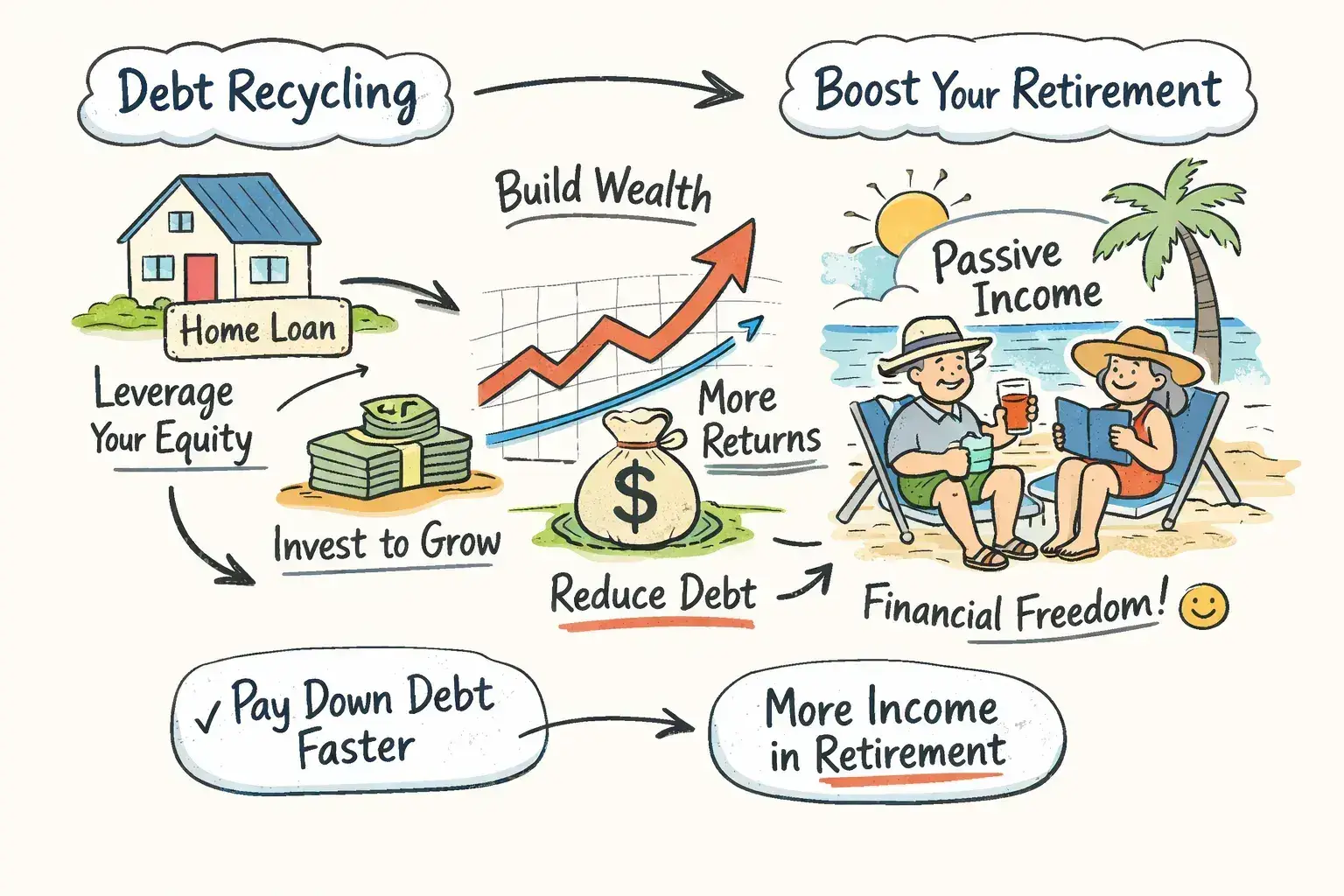
Debt recycling converts non-deductible home loan debt into potentially tax-deductible investment debt, building an investment portfolio alongside your mortgage instead of after it. The cycle is simple to describe: make extra repayments on your home loan, redraw that same amount through a separate investment loan split, and invest it in income-producing assets. The home loan shrinks, the investment side grows, and when the structure is clean, the interest on the investment loan may be deductible under the ATO’s interest deductibility rules.
It is also a leveraged strategy with real downside, strict documentation requirements and genuine tax complexity. This guide explains how it works, what the numbers look like, where it goes wrong and who it tends to suit.
Important: Debt recycling sits across financial planning and tax. Nothing here is personal financial or tax advice. Before implementing any arrangement like this, speak with a licensed financial adviser and a registered tax agent familiar with the ATO’s deductibility rules and the Part IVA anti-avoidance provisions.
How debt recycling works
Under Australian tax law, interest on money borrowed to produce assessable income (dividends, distributions, rent) is generally deductible. Interest on your home loan is not. Debt recycling works that asymmetry, one redraw at a time:
- Make an extra repayment on your home loan from surplus cash
- Redraw that amount into a separate, clearly documented investment loan split
- Invest it directly in income-producing assets, typically shares, ETFs or managed funds that pay distributions
- Repeat with next year’s surplus and the investment income
Each cycle swaps a slice of non-deductible debt for potentially deductible debt. Your total debt does not fall any faster than it would if you simply paid the surplus off the mortgage. What changes is what sits on the other side of the ledger: a growing portfolio instead of nothing.
The condition everything hangs on: tracing
The deduction only survives if every borrowed dollar can be traced directly to an income-producing investment. Separate loan splits, no shared accounts or offset pools, each redraw going straight to the investment purchase with no stop in a transaction account, and records of every step. Mix the funds or spend any of it personally, and the deduction on the contaminated portion (or in bad cases the lot) can be denied, with back taxes and interest to follow. This risk is entirely within your control, but it demands discipline for years, not months.
A worked example: $500K mortgage, $10K a year surplus
Take a $500,000 owner-occupier loan at 6.5% over 30 years, with $10,000 of genuine annual surplus. Two paths for that surplus: straight onto the mortgage, or recycled.
The mortgage result is identical either way, because the same extra repayments hit the loan in both cases. It is paid off around year 18 instead of year 30. The difference is what else exists:
| At year 20 | Surplus straight to mortgage | Debt recycling (7% return) |
|---|---|---|
| Home loan | $0 (paid off ~year 18) | $0 (paid off ~year 18) |
| Investment loan | $0 | $200,000 |
| Portfolio | $0 | ~$410,000 |
| Net position from the strategy | Debt-free | ~$210,000 ahead, geared |
At year 10, the recycler holds a portfolio of roughly $132,000 to $145,000 (at 6% to 8% returns) against a $100,000 investment loan. At year 20, the portfolio ranges from roughly $368,000 (6%) to $458,000 (8%) against the $200,000 loan.
Please note: All figures, projections and scenarios in this article are approximate and for illustrative purposes only. The table excludes fees, tax on investment income, CGT and rate changes, and assumes the investment loan interest is serviced along the way (dividends plus the tax deduction typically cover much of it, but not reliably all of it). Individual outcomes will vary based on personal circumstances, investment returns and current government policy. This is general information, not personal advice, and the after-tax version of these numbers is a job for your accountant and adviser.
Two things the table makes honest that simpler versions hide. Recycling does not pay your mortgage off faster than putting the same surplus on the mortgage directly. And the portfolio is geared: the $410,000 sits alongside a $200,000 loan, which is where the risk lives.

What Phil and Scott make of it on the podcast
Phil walked through this exact strategy in Episode 3 of the podcast, and he is upfront about how it sounds: “When I suggest to people that taking out a new loan is going to be the fastest way to pay off the home loan, they look at me like I got three heads.”
The episode’s example is the lump-sum version: a $1 million home with a $600,000 mortgage, borrowing up to 80% of the property value and investing the $200,000 difference in a broad ASX ETF, with long-term top-200 returns running near 9% a year (around 3.5% income and 5% growth). In the scenario they modelled, the strategy knocked around seven years off the mortgage and built a portfolio of roughly $300,000 alongside it, because the distributions, franking credits and tax deduction all go to work against the debt.
Phil also tells the story of what happens when leverage meets a crash. A client who geared into the market before the GFC “owed 250,000 and their portfolio was only worth about 120. I did my utmost to get them to close their eyes and ride this out. Absolutely terrible outcome.” They sold at the bottom. The episode’s other warning is about exactly that behaviour: missing just the ten best trading days over twenty years wipes out almost all of the market’s growth, and the best days cluster right next to the worst ones. The strategy only works for people who can hold on.
The tax position
The deduction rests on Section 8-1 of the Income Tax Assessment Act 1997: interest is deductible where the borrowed funds acquire assets that produce assessable income. That makes the investment choice matter. Dividend-paying shares, distributing ETFs and managed funds generally qualify. Assets that produce no income, such as speculative shares or cryptocurrency, may fail the test and take the deduction down with them.
At current rates, a $50,000 investment loan at 6.5% costs $3,250 a year in interest. For someone in the 30% bracket (32% including the Medicare levy), the deduction is worth around $1,040, bringing the net cost to roughly $2,210, against around $2,000 of dividends at a 4% yield, before franking credits. The deduction does not make borrowing free. It narrows the gap.
Part IVA, the general anti-avoidance rule, lets the ATO cancel a tax benefit where an arrangement’s dominant purpose is the tax benefit itself. Debt recycling has a legitimate commercial purpose, building an income-producing portfolio, but arrangements structured mainly to manufacture deductions invite scrutiny. For larger arrangements, a private ruling before proceeding buys certainty. Specific tax questions on any of this belong with a registered tax agent, not a blog post.
Who it tends to suit, and who it doesn’t
We generally find the strategy earns its complexity for people roughly 40 to 55, with reliable income, a meaningful equity buffer, a dependable surplus of $10,000 or more a year, and a genuine 10 to 15 year horizon before the money is needed. Closer to retirement, the sequence risk gets harder to justify: a bad first few years of a geared strategy at 58 is a very different problem from the same years at 45.
It is less likely to suit anyone with variable income or tight cash flow, anyone likely to need the invested capital within a few years, anyone on a low marginal rate where the deduction is worth little, and anyone who would find a leveraged loss genuinely hard to sit through. Phil’s GFC client is the cautionary tale: the strategy failed not on paper but in the holding.
One operational note: the loan structure matters as much as the strategy. The lender needs to offer clean facility splits, immediate redraws and statements that separate every investment draw, because that paperwork is the tracing evidence.
How it compares with the alternatives
For most Australians inside ten years of retirement, maximising concessional super contributions comes first. The 2026-27 concessional cap is $32,500 (source: ATO contribution caps, current as at October 2026), contributions are taxed at 15% against marginal rates of up to 47%, and pension-phase earnings are tax-free, all without leverage or tracing risk. Our guide on whether extra super contributions before 60 are worth it runs those numbers.
Debt recycling is most compelling after that box is ticked, for someone who still has mortgage debt, meaningful equity and surplus, and wants assets outside super’s access rules. It complements a super strategy rather than replacing it. Simply investing the surplus with no borrowing sits in between: no deduction, but no leverage risk and no tracing burden either.
What it means at retirement
A portfolio built through debt recycling provides retirement income two ways: distributions and franking credits without selling, and progressive drawdown alongside super and any Age Pension. One interaction people miss: financial assets outside super are deemed under Services Australia’s deeming rules, at 1.75% on the first $66,800 for a single ($110,600 for a couple) and 3.75% above, current as at October 2026. These rates and thresholds are set by the Australian Government and are reviewed periodically. A large outside-super portfolio affects Age Pension eligibility much like a large super balance, which is worth building into the model early rather than discovering at 67. Our guide on whether to keep investing after retirement covers how outside-super portfolios fit a retirement income plan.
Frequently asked questions
Is debt recycling legal in Australia? Yes, when properly structured and documented. It relies on the ordinary deductibility of interest on borrowings used to produce assessable income. The arrangement must have a genuine investment purpose and clean tracing; the ATO has sharpened its focus on interest deductibility claims in recent years.
Is the interest on a debt recycling loan tax-deductible? Potentially. The borrowed funds must be directly traceable to income-producing investments, never mixed with personal money, and the purpose must be genuinely to earn income. Fail the tracing and the deduction can be denied, which is why the structure is a job for a registered tax agent.
What investments suit debt recycling? Assets that produce assessable income: dividend-paying Australian shares, distributing ETFs and managed funds. Growth-only or speculative assets that pay no income may fail the income-producing test and jeopardise the deduction.
What if I accidentally spend some of the redrawn money? Mixing borrowed funds with personal spending compromises the deduction on the contaminated portion, and in bad cases the whole loan. Keep the investment facility completely separate from everyday accounts, and if a mixing error happens, speak to your tax adviser straight away.
Is debt recycling better than salary sacrificing into super? For most people, super comes first: 15% contributions tax, tax-free pension-phase earnings and no leverage, within the $32,500 concessional cap for 2026-27. Debt recycling tends to make sense as a complement once super is maximised, for people with equity, surplus and a long horizon.
How much surplus makes it worthwhile? There is no official minimum, but below roughly $5,000 to $10,000 a year the setup and compliance costs tend to outweigh the benefit, and simpler options achieve similar outcomes with less risk. The strategy compounds into something material with larger surpluses and a 10-plus year run.
Next steps
Debt recycling rewards exactly two things: clean structure and the ability to hold through bad markets. Whether it adds value in your situation depends on your surplus, your equity, your marginal rate, your horizon and your stomach for leverage, which is why the modelling matters more than the concept. Book a free consultation today to run a tailored debt recycling scenario with your actual numbers, Or take a quiz.