
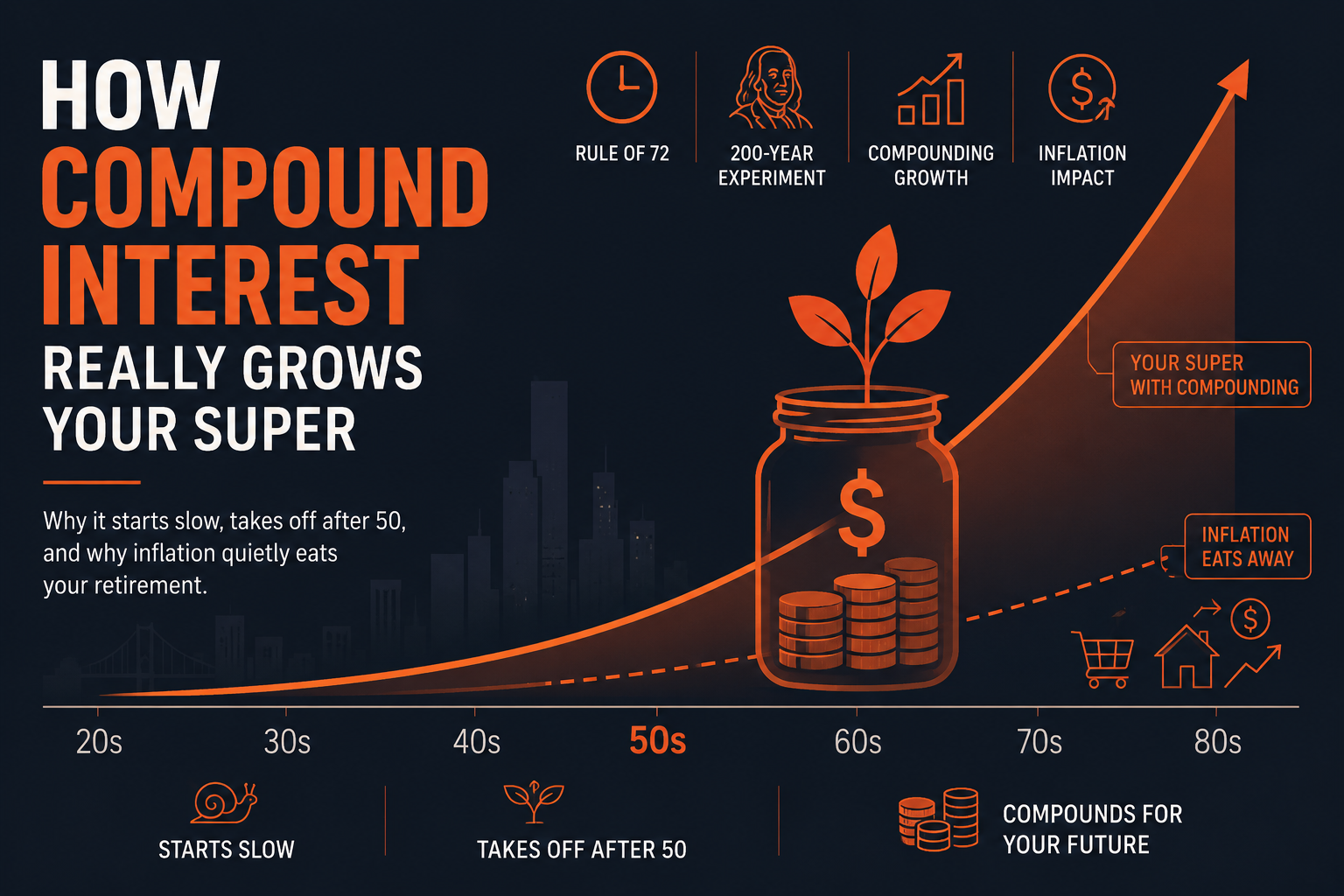
Compound interest is the reason your super balance crawls for the first 20 years of your working life and then, seemingly out of nowhere, starts doubling. If you’re 50 and wondering why your balance suddenly moves more in a year than it used to move in five, that’s compounding doing exactly what it’s supposed to do. It’s also the reason inflation quietly eats retirement savings that look perfectly healthy on a chart.
Scott and Phil dug into this on a recent episode of the Wealthlab Podcast, and it turned into one of the more useful conversations they’ve had. Here’s the thinking, with the numbers they walked through.
[EMBED: YouTube link for the compounding episode goes here on its own line]
Why your super feels like it goes nowhere for years
Phil put it plainly on the podcast: “People find it hard to wrap their heads around, because they’ve seen their super grow really slowly from the start of their working life up until their 40s and 50s. And then when I tell them it’s probably going to double between 50 and 60, their brain explodes.”
Scott’s explanation for why: “Humans are linear thinkers in an exponential world.” Our brains handle adding and rough estimates well. Growing something by 7 per cent of itself, year after year, is not something we can picture. So the early years of super feel pointless and the later years feel like magic. Neither is true. It’s the same maths the whole way through.
The same thing happens in reverse with your mortgage. For the first 15 years, the balance barely seems to move. That’s the bank collecting the benefit of compound interest. Eventually the scale tips, you’re paying more principal than interest, and it accelerates in your favour instead.
The rule of 72: a quick way to picture your money doubling
Here’s the shortcut Scott and Phil shared for getting your head around compounding. Divide 72 by your expected rate of return, and that’s roughly how many years it takes your money to double.
- A 7 per cent return doubles your money in about 10 years
- A 10 per cent return doubles it in about 7 years
Three years’ difference doesn’t sound like much. But as Scott pointed out, the gap in risk between those two returns is significant. His analogy: chasing a consistent 10 per cent is like doing 108 in a 100 zone. You might get away with it, but you’re carrying real risk of something going wrong. A well-built 7 per cent portfolio is doing the speed limit. You’re moving at an appropriate pace without taking on risk you don’t need.
Benjamin Franklin’s 200-year compounding experiment
Scott told a story on the episode that’s worth repeating. When Benjamin Franklin died in 1790, his will left a sum (around $5,000 US in today’s terms) to each of Boston and Philadelphia, with instructions that the money be invested for 200 years.
In 1990, the two cities opened the books. Boston’s fund had grown to roughly $4.5 million. Philadelphia’s reached about $2 million. Same starting amount, same time frame, more than double the difference in outcome, purely because of how each city invested. In Scott’s speed limit terms, Philadelphia spent 200 years doing 40 in a 100 zone.
Then Phil asked the question that flipped the whole story: what did inflation do over those 200 years?
Run the numbers and Philadelphia’s fund earned an annualised return of well under 2 per cent, which is roughly where long-run US inflation sat over that period. Two centuries of compounding, millions of dollars on paper, and barely any real growth in purchasing power to show for it. Boston did meaningfully better, but a large slice of even its headline result was inflation rather than genuine gains.
Compounding Works Against You Too
Compound interest has no loyalty. It works for whoever holds the asset, and it works against whoever holds the debt or faces the rising cost.
Phil made this point about mortgages on the episode: “That’s called the interest working against you. That’s the bank taking the benefit of the compound interest.” For the first 15 or so years of a typical home loan, the balance barely seems to move because most of each repayment goes to interest. Eventually the scale tips, more of each payment hits the principal, and the loan starts falling faster in your favour instead of the bank’s.
Inflation compounds the same way. Phil shared a de-identified example from a recent statement of advice. A couple planning to spend around $70,000 a year in retirement, which is close to what many retired couples spend. By the time they reach 95, that same lifestyle costs roughly $146,000 a year once inflation is projected forward. The spending did not change. The price of it doubled.
That reframes what a super balance chart actually means. A projection showing $480,000 still in super at age 95 looks comforting, until you realise that at future prices it might cover only about two years of living costs. A big number late in life is not automatically a big buffer.
What This Means for How Super Is Invested
This is where the two sides of compounding meet. If returns are compounding at 2 to 3 per cent while living costs are compounding at a similar rate, the money is treading water in real terms, and the problem gets slightly worse every year.
Phil raised a pattern we see often: some life stage super products automatically shift members into very conservative settings by their mid 60s. We generally find that retirees need their money working for another 25 to 30 years, a point we also make in our guide to retirement in Australia and how super and the Age Pension fit together, and an allocation that barely matches inflation over that stretch can mean the money runs out much sooner than the chart suggested. Whether any particular investment mix suits your situation depends entirely on your circumstances, timeframe and comfort with short-term movement, which is a conversation worth having with a qualified adviser.
Scott’s line on the episode sums up the mindset shift: “People look at me like I’m crazy when I say it, but actually not taking enough risk is probably one of the biggest risks you have.” We unpacked the same idea with real portfolio numbers in our episode on why playing it safe in retirement can cost you more, where a couple with $500K in super spending $75K a year saw a growth portfolio fund them into their late 90s while a conservative one ran out 15 years earlier.
Want to see how compounding, inflation and your own balance fit together? Run your numbers through the free Wealthlab super calculator. It takes two minutes and gives a clearer picture than any average ever could.
FAQ
What is the rule of 72?
The rule of 72 is a quick way to estimate how long an investment takes to double. Divide 72 by the expected annual return. A 7 per cent return doubles your money in roughly 10 years, while a 10 per cent return doubles it in about 7 years.
Why does super grow faster after 50?
Compounding builds on itself. A larger balance earning the same percentage return produces bigger dollar gains, so growth accelerates in the later decades of your working life. Many people find their balance doubles between 50 and 60 even without large extra contributions.
Does inflation affect my retirement savings?
Yes. Inflation compounds just like investment returns do. Spending of $70,000 a year today can grow to well over $140,000 a year within 30 years at typical inflation rates, so retirement projections need to account for rising costs, not just today’s budget.
Is a conservative super investment option safer in retirement?
Not always. If returns fall below inflation, purchasing power shrinks every year and savings can run out sooner. Investment risk in super usually means short-term volatility rather than permanent loss, and the right mix depends on individual circumstances. Speak with a qualified financial adviser before changing your investment option.
Is it too late to benefit from compounding if I’m over 50?
No. Money in super at 50 still has decades of potential compounding ahead of it, both before retirement and through retirement itself, since most retirees stay invested well into their 80s and 90s. Time still works in your favour, just over a shorter runway.
Did Albert Einstein really call compound interest the eighth wonder of the world?
Probably not. There’s no reliable record of Einstein saying it, as Scott noted at the top of the podcast episode. The maths behind the quote holds up regardless of who said it.
Want to talk it through?
If this has raised questions about how your own super is invested or how long your money might last, have a chat with us. No pressure, no jargon.