

Many Australians reach age 60 with savings or super balances that fall short of what financial experts call ideal. If you have saved $230,000 and are wondering whether you can retire at 60, the answer is yes, it is possible, but it will require a modest lifestyle, disciplined planning and strategic use of government support when it becomes available.
Here we break down how far $230K can stretch, what kind of retirement lifestyle it might support, and how to manage the crucial gap between age 60 and 67 when the Age Pension begins.
What Happens Financially at 60 in Australia?
Turning 60 marks a key milestone. You have reached your preservation age, which means you can access your super tax-free once you have retired. You can set up a tax-effective income stream from your superannuation. But you are still seven years away from the Age Pension, which begins at 67.
Retiring at 60 means fully funding your own lifestyle, including healthcare, housing and daily expenses, for at least seven years before any government support kicks in.
What Does $230K Mean in Retirement?
$230,000 in super at 60 sits close to the median super balance for Australian women in the 60 to 64 age bracket and slightly below the median for men. It is not a large balance by comfortable retirement standards, but it is not unusual.
In retirement terms, $230K represents roughly seven to eight years of modest income at $26,000 to $28,000 a year, assuming moderate investment growth in an account-based pension. The goal is not to last indefinitely on $230K alone. It is to bridge the seven-year gap to pension age with enough left over that the Age Pension can take over as the main income source at 67.
What Retirement Costs Look Like
According to the ASFA Retirement Standard (February 2026 update):
- $35,199 a year for a modest lifestyle (single homeowner)
- $54,240 a year for a comfortable lifestyle (single homeowner)
- $50,866 a year for a modest lifestyle (couple homeowners)
- $77,375 a year for a comfortable lifestyle (couple homeowners)
With $230,000, spending around $26,000 to $28,000 a year is necessary to make it through the 60 to 67 period with something remaining. This is below the ASFA modest standard, but workable for a homeowner with no debt and modest lifestyle expectations.
How Long Will $230k Last in Retirement?
Here’s a projection assuming:
- Annual drawdown: ~$28,000
- Annual investment return: 3%
| Age | Starting Balance | Withdrawal | Growth (3%) | Ending Balance |
|---|---|---|---|---|
| 60 | $230,000 | $28,000 | $6,000 | $208,000 |
| 61 | $208,000 | $28,500 | $5,500 | $185,000 |
| 62 | $185,000 | $29,000 | $4,900 | $160,900 |
| 63 | $160,900 | $29,500 | $4,300 | $135,700 |
| 64 | $135,700 | $30,000 | $3,600 | $109,300 |
| 65 | $109,300 | $30,500 | $2,700 | $81,500 |
| 66 | $81,500 | $31,000 | $2,000 | $52,500 |
| 67 | $52,500 | $10,000 | $1,600 | $44,100 |
This shows that with careful budgeting, $230k can cover your early retirement years, and still leave you with a modest buffer once the Age Pension begins.
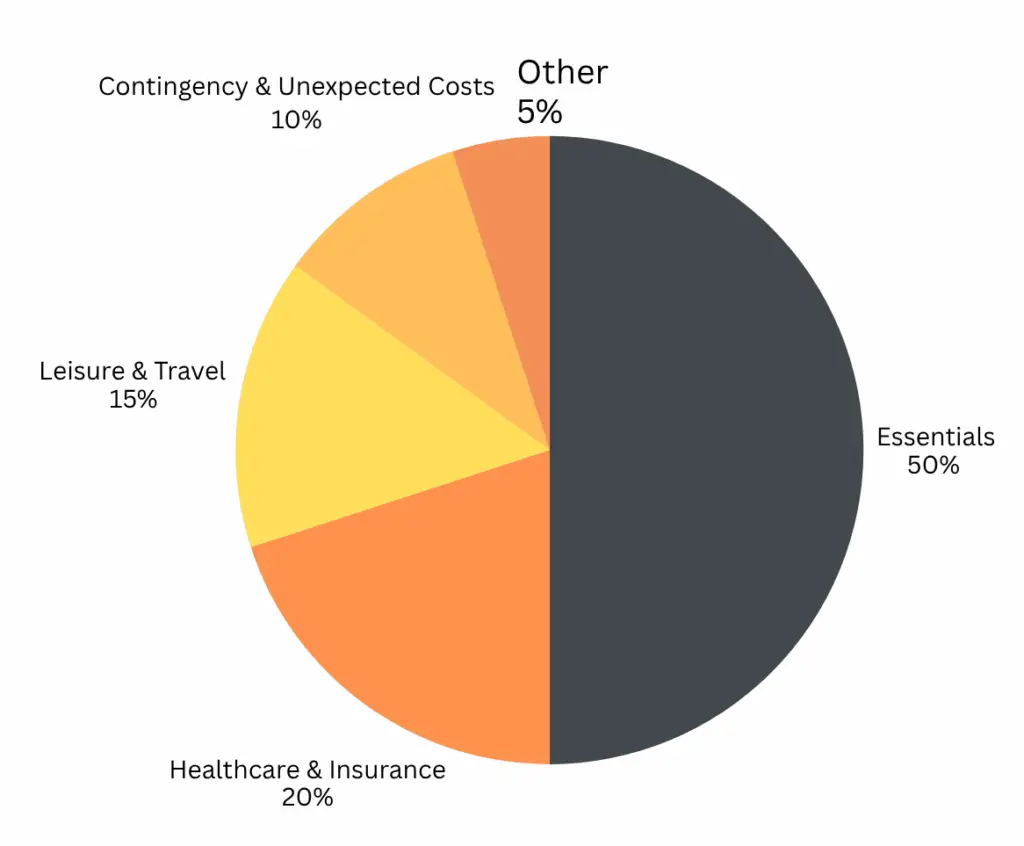
How Long Will $230K Last in Retirement?
Projection assuming $28,000 annual withdrawals and 5% net annual return in an account-based pension:
| Age | Starting balance | Withdrawal | Net growth (5%) | Ending balance |
|---|---|---|---|---|
| 60 | $230,000 | $28,000 | $10,100 | $212,100 |
| 61 | $212,100 | $28,000 | $9,205 | $193,305 |
| 62 | $193,305 | $28,000 | $8,265 | $173,570 |
| 63 | $173,570 | $28,000 | $7,279 | $152,849 |
| 64 | $152,849 | $28,000 | $6,242 | $131,091 |
| 65 | $131,091 | $28,000 | $5,155 | $108,246 |
| 66 | $108,246 | $28,000 | $4,012 | $84,258 |
| 67 | $84,258 | $15,000 | $3,463 | $72,721 |
By 67, there is still around $72,000 in super and the Age Pension is now supplementing income. With assets well under the full pension threshold of roughly $314,000 for a single homeowner, you would very likely receive the full Age Pension rate of approximately $29,754 a year.
What Happens at Age 67?
You become eligible for the Age Pension at 67, subject to income and assets tests. With a super balance drawn down from $230K over seven years, you will very likely qualify for the full pension. Once it starts, you need to draw down only small amounts from your remaining super, helping it last well into your 80s.
Current Age Pension rates for 2026:
- Single: approximately $29,754 a year (including supplements)
- Couple (combined): approximately $44,856 a year (including supplements)
What Turning 60 Means for Your Finances in Australia
Sixty is a significant financial milestone regardless of your super balance. The key things that change at 60:
You can access your super tax-free once you have met a condition of release. For most people this means retiring from the workforce or leaving an employer after turning 60.
You can set up a transition to retirement (TTR) pension if you are still working, drawing up to 10% of your super balance as income each year while still employed.
You cannot yet access the Age Pension. That requires reaching 67. You also cannot access the Commonwealth Seniors Health Card until pension age.
State-based concession cards vary: some are available before 67 depending on your circumstances and state of residence. It is worth checking with your state government what you qualify for at 60.
Retiring to Australia from the UK at 60: What You Need to Know
This post draws impressions from searches like “retire to australia from uk” and “can you emigrate to australia if you are over 60”, which points to a distinct audience: people born in the UK or with UK ties who are considering retiring in Australia.
The key things to understand if you are moving to Australia from the UK to retire:
Visa requirements. Australia does not have a dedicated retirement visa for people over 60, unlike some countries. The most common pathways are through family visas (if you have an Australian citizen or permanent resident child who can sponsor you), the Investor Retirement visa (subclass 405, which requires significant assets and ongoing income) or applying for permanent residency through other streams. Immigration rules change regularly, so checking with a registered migration agent is essential.
Superannuation access. If you have been working in Australia previously and have an existing super balance, the rules above apply: you can access it tax-free from 60. If you are new to Australia, you will not have a super balance unless you start working here and accumulating contributions.
Age Pension eligibility. The Australian Age Pension has a residency requirement. You generally need to have been an Australian resident for at least 10 years (with at least 5 years continuous) to qualify. Someone moving to Australia at 60 may need to wait several years before becoming eligible. Australia and the UK have a social security agreement that can help with this, but the details are specific to individual circumstances.
UK State Pension. If you have UK National Insurance contributions, you may still be entitled to a UK State Pension, which can be paid to you anywhere in the world. The rate is typically frozen at the rate applicable when you left the UK if you retire to Australia, due to Australia not being on the UK’s reciprocal agreement list for pension uprating. This is a notable trap: your UK pension will not increase with UK inflation once you move to Australia.
Tax. Australian tax residency rules apply once you are living here. Your UK pension income may be taxable in Australia. A tax adviser familiar with both systems is worth engaging before you make the move.
Strategies to Make $230K Last Longer
Delay retirement by one to two years. Even 12 extra months of contributions and reduced drawdown can add meaningful runway.
Spend temporarily below $28,000 a year before 67. The tighter the budget in the early years, the more is left when the Age Pension arrives.
Combine part-time work or other income with your super. Even $15,000 to $20,000 a year from casual work dramatically reduces how fast you draw down.
Plan for Age Pension eligibility now. Understanding the assets test and how your super balance interacts with it can help you structure withdrawals to maximise pension entitlements at 67.
How to Make Retirement Work on $230,000
Pay off your home first. Eliminating rent or mortgage payments before retirement is one of the most effective ways to reduce annual expenses. Without repayments, your budget stretches considerably further.
Draw a super income stream. Converting your super into an account-based pension allows for regular, tax-free income while keeping withdrawals controlled. Avoid large lump sum withdrawals that deplete your balance too quickly.
Budget below the modest lifestyle standard. The ASFA modest lifestyle assumes $35,199 a year for singles, but careful planning can reduce that to $26,000 to $28,000. Discounts, public transport concessions and reduced discretionary spending make a real difference.
Keep some growth in your portfolio. Holding everything in cash will not keep pace with inflation over a 30-year retirement. A balanced investment option with 50 to 60% growth assets is generally more appropriate than a conservative or cash-only strategy.
Supplement with casual or freelance work. Even five to ten hours of flexible work a week makes a significant difference. Working until 62 or 63 can preserve tens of thousands in your retirement fund and may improve your Age Pension position at 67.
What Lifestyle Can $230K Support?
| Category | Expectation |
|---|---|
| Housing | Must own your home outright |
| Food and utilities | Covered with careful budgeting |
| Travel | Local trips, limited interstate, no overseas |
| Healthcare | Public system with basic extras cover |
| Discretionary spending | Low to moderate |

Mistakes to Avoid on a $230K Retirement Plan
Rushing to withdraw large lump sums from super depletes your balance far faster than regular account-based pension drawdowns. Ignoring the 60 to 67 pension gap and assuming government support arrives earlier than it does is a common and costly mistake. Overestimating investment returns leads to over-spending in the early years. Forgetting to factor in rising health and living costs leaves people short later in retirement. And not getting professional financial advice before making the retirement decision is the single easiest mistake to avoid.
FAQs: Retiring at 60 with $230K in Australia
Can I retire at 60 with $230K in Australia?
Yes, for a homeowner spending around $26,000 to $28,000 a year. $230K is below the ASFA comfortable retirement benchmark, but workable with careful management. The Age Pension at 67 provides meaningful income from that point.
What does $230K mean in retirement terms?
At 5% net annual return with $28,000 annual spending, $230K covers approximately seven to eight years of income before drawing down significantly. Combined with the full Age Pension from 67, it can fund retirement well into your 80s.
Can you retire to Australia from the UK at 60?
You can move to Australia at 60, but there is no dedicated retirement visa. Common pathways include family sponsorship or the Investor Retirement visa (subclass 405). Age Pension eligibility in Australia requires 10 years of residence. Your UK State Pension will likely be frozen at the rate when you leave, as Australia is not on the UK uprating list. Speaking with a registered migration agent and a cross-border tax adviser before making the move is essential.
Can you emigrate to Australia if you are over 60?
Yes, emigrating to Australia over 60 is possible but pathways are limited. The most realistic options are family visas (if you have an Australian child who can sponsor you), the Investor Retirement visa for those with significant assets, or employer-sponsored visas if you are still working. General skilled migration visas have age limits, typically up to 45 years old.
What do you qualify for when turning 60 in Australia?
At 60 you can access your super tax-free once you have retired. You can also set up a transition to retirement pension if still working. The Age Pension, Commonwealth Seniors Health Card and most concession entitlements start at 67, not 60. Some state-based concessions are available earlier, depending on your state and circumstances.
How long will $230K last in retirement at 60?
At $28,000 annual spending and 5% net return, $230K would leave around $72,000 in super at age 67. From that point the Age Pension supplements your income, and your remaining super can extend your retirement income into your late 80s and beyond.
Want to know exactly what $230K means for your retirement? Book a free call with the Wealthlab team,or take the free Wealthlab retirement quiz .