

Welcome to the 1st of July — we hope your inbox made it through the EOFY frenzy of sales, super deadlines, and “final hours” offers.
Whether you snapped up something tax-deductible or just quietly let the chaos pass, consider this your cue to exhale.Now that the dust has settled, here’s your July update with things that actually may make a difference to your financial future — starting with WAR
(oh god pls help)….
Money & the Quiet Death of ESG Funds
Last month, NATO leaders made history: a bold new pledge to increase defense spending to 5% of GDP by 2035 — more than doubling the current 2% benchmark.

That’s not just a policy tweak — it’s an eye-watering US$1.9 trillion in additional annual defence spending across NATO nations.
So ahh great – we’ve now got a bigger military industrial complex across the planet & less stability. Wasn’t blockchain or crypto supposed to fix all this like we were promised in 2021.
Roughly 3.5% is earmarked for hard defense (troops, weapons, gear), and 1.5% for critical infrastructure like cybersecurity, energy, pipelines, and ports. In plain English? It’s the biggest defense spending boom since the Cold War. Yay -_-
European defense stocks popped immediately:
- 🇩🇪 Germany’s Rheinmetall: +3%
- 🇮🇹 Italy’s Fincantieri: +6%
- 🇬🇧 BAE Systems: +4%
Even ETFs like the STOXX Europe Aerospace & Defense ETF rose over 1.4% in a single day.
And here’s a little admission: while researching this piece, I discovered something surprising — Australia isn’t a NATO member.
(Huh. I assumed we were… but nope. We’re just “a close partner.”)
That said, the ripple effect is real. Australia is now under renewed pressure to boost our own defence budget, especially as tensions rise in the Indo-Pacific. We currently spend around 2.05% of GDP, with plans to hit 2.3% by 2034, but compared to NATO’s new 5% benchmark — we’re trailing.
So who benefits here?
Locally:
- Austal (naval shipbuilding) is a major contractor.
- Electro Optic Systems is gaining global traction in weapons and satellite systems.
- Codan is a quiet achiever in secure communications, with global defense clients.
Globally:
- US giants like Raytheon and Lockheed Martin are forming joint ventures to build in Europe — and their suppliers (many of them Aussie-based) are likely to benefit downstream.
Meanwhile… where are the ESG funds?
After years of preaching that weapons, fossil fuels and mining were taboo, ESG investing has gone awfully quiet. The truth is, when the world gets unstable, investors follow the money — and the money is going to security, infrastructure, and energy. Not solar-powered think pieces which is a shame.
Market Snapshot: Interest Rates vs US Debt vs Reality
Global interest rates might’ve peaked — and markets are already sniffing out rate cuts. But beneath the headlines is another elephant in the room: the US debt ceiling.
The US national debt now sits at a staggering US$35 trillion, and servicing that debt is consuming a larger chunk of government spending than defence or Medicare. If rates stay elevated, the math simply doesn’t work — and markets know it.
That’s part of why:
- The US Fed paused and is cautiously softening its language.
- Bond markets are hinting at cuts before year-end.
- Risk assets are still holding up — for now.
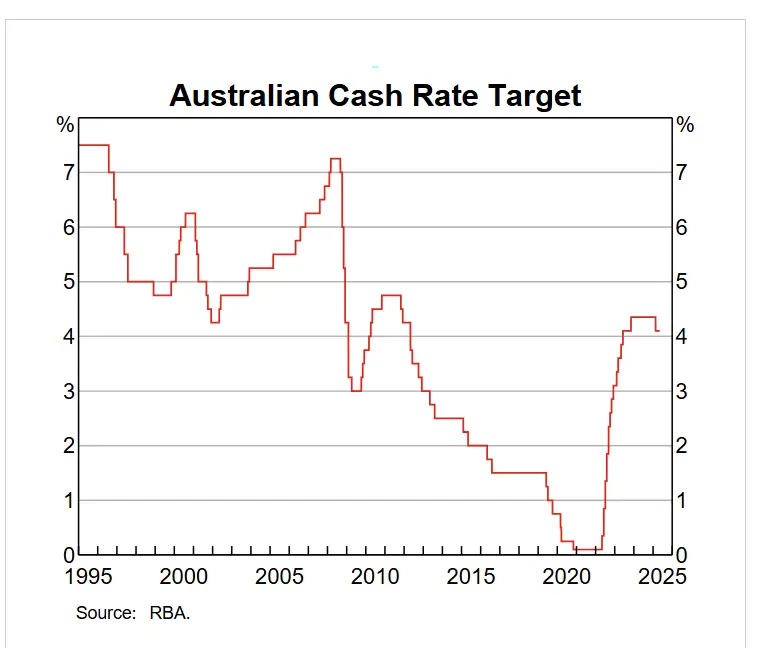
Here in Australia, the RBA is still posturing tough (3.85%), but we’re increasingly influenced by what happens in the US. As the chart shows, our rate hikes lagged, and we may also lag the cuts — but the direction is clear: the peak looks to be turning.
Podcast Spotlight: We Found the Worst Super Fund in the Country
This month, Scott and Phil go digging — using the ATO’s comparison tool to uncover what might just be the worst-performing super fund in Australia.

Spoiler: The numbers don’t add up, the rankings contradict themselves, and some of the top funds are… also at the bottom. Confused? So were we.
In this episode:
- Why life-cycle super options often fail retirees.
- How poor data, outdated returns, and shady licensing fees make it hard to compare funds fairly.
- What to actually look at when assessing your super performance.
Ready for a Mid-Year Check-In?
July’s the perfect time to reset, review, and re-align — especially if you’ve been:
- Wondering if your super is doing what it should be.
- Sitting on extra savings with no plan.
- Trying to figure out if you can work less, invest more, or just feel clearer.
If it’s been a while since we’ve had a chat (or if you’ve referred someone to us recently), now’s a great time to book a quick mid-year review session.
Thanks for reading and for being part of the Wealthlab community.
More sharp insights coming your way next month.