
$460,000 in super at 60 is a solid starting point for retirement and above the median Australian balance at this age. Whether it is enough depends on what you want retirement to look like, whether you own your home, and how you manage the seven-year gap before the Age Pension starts at 67.
This article uses $460K as the worked example throughout, covers how much you actually need to retire at 60 in Australia across different spending levels, addresses the $400K to $500K balance range many people are searching, and explains what changes when the Age Pension arrives.
How Much Do You Need to Retire at 60 in Australia?
There is no single answer, but there are honest benchmarks.
The ASFA Retirement Standard (February 2026 update) puts annual retirement costs for a homeowner at:
- Single, modest lifestyle: $35,199 a year
- Single, comfortable lifestyle: $54,240 a year
- Couple, modest lifestyle: $50,866 a year
- Couple, comfortable lifestyle: $77,375 a year
ASFA’s lump sum benchmarks assume retirement at 67 with the Age Pension supplementing from day one: $630,000 for a single person and approximately $690,000 to $730,000 for a couple. Retiring at 60 means seven more years of drawdown before the pension arrives — so the balance you need at 60 is higher than these figures suggest.
As a practical guide for a single homeowner retiring at 60 with 5% net returns:
| Annual spending | Super needed at 60 | Balance at 67 (est.) | Age Pension from 67 |
|---|---|---|---|
| $28,000 | $290,000–$330,000 | ~$170,000–$200,000 | Near full |
| $33,000 | $350,000–$400,000 | ~$230,000–$270,000 | Near full |
| $38,000 | $430,000–$480,000 | ~$275,000–$310,000 | Near full to part |
| $45,000 | $530,000–$590,000 | ~$290,000–$350,000 | Part pension |
| $54,000 | $650,000–$720,000 | ~$320,000–$400,000 | Part pension initially |
At $460K, a single homeowner spending $36,000 to $39,000 a year sits comfortably in this table, above modest, approaching the comfortable standard, arriving at 67 with enough remaining for near-full or close-to-full pension entitlements.
Please note: All figures are approximate and for illustrative purposes only. Individual outcomes will vary based on spending, investment returns, fees and personal circumstances. This is general information, not personal advice.
What $460K Looks Like Year by Year: 60 to 67
Projection assuming an account-based pension with 5% net annual return:
| Age | Opening balance | Withdrawal | Net growth (5%) | Closing balance |
|---|---|---|---|---|
| 60 | $460,000 | $36,000 | $21,200 | $445,200 |
| 61 | $445,200 | $36,500 | $20,435 | $429,135 |
| 62 | $429,135 | $37,000 | $19,607 | $411,742 |
| 63 | $411,742 | $37,500 | $18,712 | $392,954 |
| 64 | $392,954 | $38,000 | $17,748 | $372,702 |
| 65 | $372,702 | $38,000 | $16,735 | $351,437 |
| 66 | $351,437 | $38,000 | $15,672 | $329,109 |
| 67 | $329,109 | Pension starts | ~$306,000 |
At 67, approximately $306,000 remains and the Age Pension begins. For a single homeowner, this sits very close to the full pension assets test threshold of $314,000 (current as at May 2026, Services Australia). At $306,000, near-full pension entitlements are likely, with only a minor taper reduction if any.
Combined income from 67: near-full pension of approximately $29,754 plus modest drawdown from $306,000 puts total annual income in the range of $40,000 to $48,000. A comfortable, sustainable position for a homeowner well into the 80s.
How to Retire on $460
To make $460K work in retirement, follow these steps:
- Calculate Your Retirement Income Needs – Determine how much you need per year to live comfortably (e.g., $35,000).
- Determine Investment Returns Required – Reverse engineer the returns required to meet your income goals, considering inflation and Age Pension eligibility.
- Select Appropriate Investment Options – Choose a mix of growth and defensive assets in super to balance risk and returns.
- Monitor and Adjust – Regularly review your retirement plan to adapt to changes in market conditions, health, or lifestyle.
Is $400K to $500K Enough to Retire at 60?
The GSC data for this post shows significant search volume for “can I retire at 60 with 400k,” “is 400k enough to retire at 60,” “can I retire at 60 with 450k,” “retire at 60 with 400k” and “how much will 400k last in retirement.” These are all people searching adjacent to $460K. Here is the honest answer across that range.
$400K at 60 (single homeowner, $32,000 annual spending): Workable but tight. Seven-year gap requires careful spending discipline. Arrives at 67 with approximately $220,000 to $240,000, well under the full pension threshold. Near-full pension from 67. Combined income from 67 around $37,000 to $42,000. Modest but manageable for a homeowner without debt.
$430K at 60 (single homeowner, $35,000 annual spending): Solid. Above median Australian balance. Arrives at 67 with approximately $270,000 to $290,000. Near-full pension. Combined income from 67 around $39,000 to $44,000.
$460K at 60 (single homeowner, $37,000 annual spending): The scenario in this article. Strong position. Arrives at 67 with approximately $300,000 to $310,000. Near-full or full pension from 67. Combined income $40,000 to $48,000.
$500K at 60 (single homeowner, $40,000 annual spending): Approaching the threshold of comfortable retirement. Arrives at 67 with approximately $310,000 to $330,000. Likely near-full to part pension depending on exact balance. Combined income from 67 up to $48,000 to $52,000.
The honest read across this range: any balance from $400K to $500K at 60 is workable for a single homeowner spending carefully, particularly once the Age Pension supplements income from 67. The difference between $400K and $500K shows up most in the spending comfort during the gap years and the buffer available for unexpected costs in the 70s and 80s.
What Does $460K in Retirement Mean in Practice?
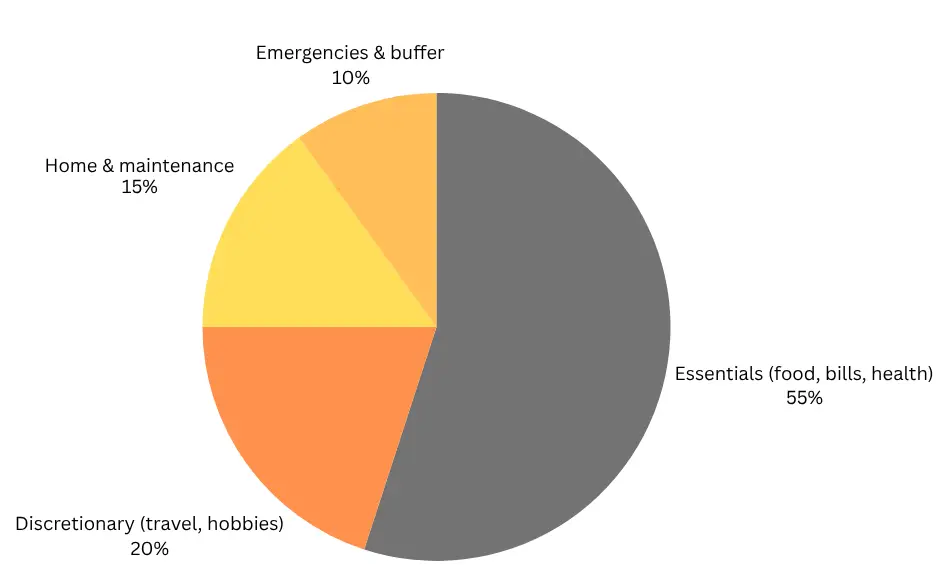
A sample $37,000 annual budget for a single homeowner:
| Category | Annual spend |
|---|---|
| Groceries and food | $9,500 |
| Housing costs, rates and insurance | $6,500 |
| Healthcare and out-of-pocket medical | $6,500 |
| Transport and vehicle running costs | $5,000 |
| Domestic travel and leisure | $6,000 |
| Utilities, phone and subscriptions | $2,500 |
| Dining out and social activities | $1,000 |
This sits just above ASFA’s modest standard of $35,199 and below the comfortable standard of $54,240. For a debt-free homeowner, it covers all essentials plus genuine leisure and regular domestic travel. Not a constrained budget. Not a lavish one. A comfortable, active retirement for most homeowners.
The Age Pension from 67: What $460K Gets You
Current Age Pension rates as at May 2026 (Services Australia):
- Single (including supplements): approximately $29,754 a year
- Couple combined (including supplements): approximately $44,856 a year
Updated each March and September.
Arriving at 67 with approximately $306,000, a single homeowner is right at or just under the full pension threshold of $314,000. Near-full pension from day one. Combined with a conservative 3% to 4% drawdown from the remaining balance, total annual income from 67 is in the range of $40,000 to $48,000, sustained by the combination of pension plus investment returns on the remaining balance for many years.
Phil and Dan walked through exactly how the assets test and income test interact with different balances at 67 in Episode 10 of the Wealthlab Podcast, including real case studies. Watch Episode 10 on YouTube.
Our pension and Centrelink page covers the application process, test thresholds and how to structure assets before pension age.
Payday Super: How It Affects Your $460K Balance
“Impact of payday super” is appearing as a query for this post and it is a relevant, current question for Australians approaching retirement.
From 1 July 2026, employers in Australia will be required to pay superannuation at the same time as wages, moving from the current quarterly payment system to payday super. This change has two implications for people with a balance around $460K:
If you are still working: Payday super means contributions arrive in your account more frequently, giving them more time to compound before you retire. The investment impact depends on your fund’s unit pricing timing, but more frequent contributions generally produce slightly better outcomes over time due to more consistent compounding.
If you have already retired: Payday super does not directly affect your account-based pension, as employer contributions are no longer being made. However, it may affect a spouse or partner still working and building their balance.
For compliance purposes: Payday super increases the administrative burden on employers and introduces real-time visibility of super payment status through the ATO. For employees, it provides easier verification that super is being paid correctly.
The broader context: payday super is designed to reduce the $3.4 billion in unpaid super owed to Australian workers annually, ensuring more Australians retire with the balance they are actually owed. For someone approaching retirement with $460K, confirming your super is being paid correctly before you retire is a worthwhile step.
How Long Will $1 Million in Super Last? (For Context)
“How long will $1 million in super last in Australia” is also appearing for this post. Briefly, for context:
At $54,000 a year spending (ASFA comfortable standard) and 5% net return, $1 million in an account-based pension at 60 lasts approximately 35 to 40 years before drawing down significantly. At 67 when the Age Pension starts supplementing income, the combined income reduces drawdown pressure substantially and the balance continues well into the late 80s to 90s. The Age Pension is still relevant even at $1 million, as the balance draws down below the full pension threshold in the 70s or 80s depending on spending.
Our retirement planning page has more on higher-balance retirement scenarios.
What Makes the Difference at $460K
Own your home before you retire. Every projection above assumes zero housing costs. Carrying rent or a mortgage at $460K fundamentally changes the sustainability of the plan .Stay invested for growth. A $460K retiree who moves everything to cash at 60 loses ground to inflation every year. A balanced investment option keeps returns ahead of inflation through the gap years. Scott covered this directly in Episode 1 of the Wealthlab Podcast. Watch Episode 1 here.
Spend conservatively in the early years. Drawing $45,000 to $50,000 a year from $460K in years one to three puts real pressure on the balance at 67 and the Age Pension position. Keeping spending close to $36,000 to $38,000 preserves the buffer that makes retirement genuinely comfortable from 67 onwards.
Plan the Age Pension before 67. Getting advice on how to structure your assets two to three years before pension age, not the week after your 67th birthday, makes a material difference to entitlements from day one. Episode 9 covers a real case where super fund advice caused an avoidable Age Pension loss. Watch Episode 9 here.
The free Wealthlab super calculator models your specific balance, spending and timeline in a couple of minutes.
FAQ: Retiring at 60 with $460K in Australia
Can I retire at 60 with $460K in Australia? For a single homeowner spending $36,000 to $39,000 a year, yes. At 5% net return, $460K leaves approximately $306,000 at 67 when the Age Pension begins, with near-full pension entitlements. Combined income from 67 is in the range of $40,000 to $48,000, a comfortable, sustainable position for a homeowner.
How much do you need to retire at 60 in Australia? For a single homeowner, roughly $330,000 to $400,000 for a modest lifestyle ($32,000–$35,000 a year) and $450,000 to $530,000 for a mid-range lifestyle ($37,000–$42,000 a year). A comfortable lifestyle at $54,000 a year requires $650,000 to $720,000. These are at-60 starting figures; ASFA’s benchmarks assume retirement at 67.
Is $400K enough to retire at 60 in Australia? For a single homeowner spending $30,000 to $32,000 a year, yes. $400K arrives at 67 with approximately $220,000 to $250,000, well under the full pension threshold. Near-full pension from 67 combined with modest drawdown provides around $36,000 to $40,000 a year. Workable for a homeowner, tight for a renter or couple.
How much super should I have at 60? As a benchmark, a single homeowner targeting a modest-to-mid lifestyle ($33,000–$38,000 a year) in retirement should aim for $380,000 to $480,000 at 60. For a comfortable lifestyle, $580,000 to $720,000. Couples need more in combined terms. The Age Pension from 67 makes lower balances workable for homeowners.
What is payday super and how does it affect retirement? Payday super requires employers to pay super contributions on each pay day from 1 July 2026, replacing the current quarterly system. For people still working, it means contributions compound more frequently. For people already retired with an account-based pension, it has no direct effect. It is designed to reduce unpaid super across the workforce.
How long will $460K last in retirement from age 60? At $36,000 to $38,000 annual spending and 5% net return, $460K reaches age 67 with approximately $300,000 remaining. With near-full Age Pension supplementing income from 67, combined income sustains a homeowner comfortably into the mid to late 80s.
What is the Age Pension for a single person in 2026? Approximately $29,754 a year including supplements, as at May 2026. Updated each March and September. Current rates at Services Australia..
Can I retire at 60 with 450K or 400K instead of 460K? Yes, on similar spending. $450K and $400K at 60 both produce workable retirement outcomes for a single homeowner spending modestly, with the key difference being how much buffer remains at 67 and in the years beyond. The $460K table above is a useful guide for balances across the $400K to $500K range.
How long will $1 million in super last in Australia? At the ASFA comfortable standard of $54,000 a year and 5% net return, $1 million in an account-based pension from age 60 lasts well into the late 80s to 90s, with the Age Pension supplementing from 67 and reducing drawdown pressure significantly.
How much super do I need to retire on $100,000 a year at 60? To spend $100,000 a year from age 60 and sustain that through the gap years, a starting balance of approximately $1.3 million to $1.5 million at 60 is a rough guide, depending on investment returns. The Age Pension may not be relevant at this spending level until the balance draws down significantly.
What to Do Next
At $460K you have a solid retirement base. The difference between a retirement that is genuinely comfortable and one that runs tight comes down to spending discipline in the gap years, investment mix, and Age Pension positioning at 67. Getting those decisions structured before you retire is worth considerably more than adjusting them two years in.
Not sure exactly where you stand? take the free Wealthlab retirement quiz for a general snapshot. Or book a free, no-pressure chat with the Wealthlab team to work through your specific numbers.