
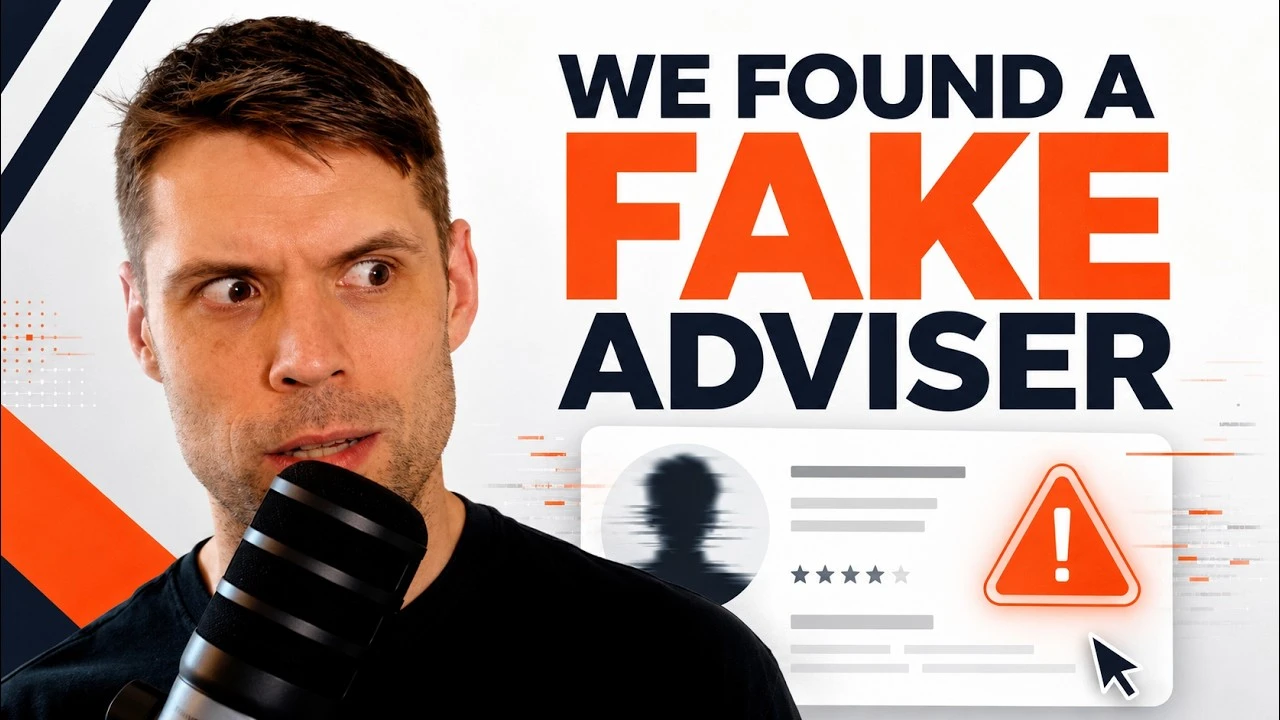
A Wealthlab client recently sent us a YouTube channel that looked, on the surface, like a legitimate source of Australian tax and financial information. A retired accountant named “Steve,” 40 years of practice, friendly delivery, useful-sounding tips on tax and Centrelink.
Something was off. The lip movements didn’t quite sync with the voice. The channel was less than four weeks old but pulling unusually high view counts. When we dug into the linked website, the giveaway was right there in italics at the bottom of the page: “Steve is a character. The face and the voice are not real. Steve is not a tax agent nor a financial adviser.”
The entire operation, voice, face, script, website, was AI-generated. And it was selling a book.
This isn’t a one-off. ASIC has spent the first half of 2026 warning Australians, particularly younger Australians, that what they’re seeing online is increasingly synthetic, increasingly persuasive, and increasingly unlicensed. If you, or anyone in your family, takes financial guidance from social media or YouTube, the points below are worth a few minutes.
What ASIC is actually saying about AI financial advice
ASIC Commissioner Alan Kirkland has been direct on this throughout 2026: “Financial information on social media and accessed through AI tools can be incomplete, promotional or misleading.”
The Moneysmart Gen Z research published in March 2026 told a worrying story:
- 63% of Australians aged 18 to 28 use social media for financial information and guidance
- 30% specifically watch YouTube for financial advice
- 18% use AI platforms (chatbots) for financial advice
- 52% trust “finfluencers” somewhat or completely
- 64% trust AI platforms for financial information, the highest-trusted source in the survey
In April 2026, ASIC issued formal warning notices to four Australian finfluencers suspected of providing unlicensed financial advice or making misleading representations, including claims of guaranteed returns. The regulator is also reviewing several AFS licensees responsible for supervising 15 finfluencers operating under their licences.
The penalty for providing financial product advice in Australia without an AFS licence is severe: up to five years’ imprisonment for individuals and multi-million-dollar fines for corporations. None of which helps you get your money back if the “adviser” turns out to be a synthetic character generated by a Claude prompt and a video model.
The pattern: how AI financial advice channels are built
The Steve example we came across follows a template that’s becoming common. Worth knowing what to look for.
A brand-new channel with disproportionate engagement. Channels less than a few months old generating tens of thousands of views per video, often without an obvious external promotion source.
A friendly, slightly off-looking presenter. The “uncanny valley” effect, where the face is almost right but something feels wrong. Common giveaways include lip sync that drifts, eyes that don’t quite focus, hands that disappear or have the wrong number of fingers (yes, still a tell with some models), and overly smooth skin texture.
Voice that doesn’t match the face. AI-generated voice tracks are often laid over an AI-generated avatar. The cadence is fluid, but the pacing rarely matches the natural rhythm of the lip movement.
Generic content, suspiciously confident delivery. “Steve” was delivering content about Centrelink, ATO audit correspondence, and tax outcomes, all delivered with the certainty of someone who has personally handled thousands of cases. The website said he had. The website was also AI-generated.
A disclaimer buried in italics. This is the one that genuinely matters. On the Steve channel, the website included a line of italicised text near the bottom of an “about” page: “Steve is a character. The face and the voice are not real. Steve is not a tax agent nor a financial adviser.” That sentence is doing a lot of legal work for whoever is running the operation. It’s the thread the entire structure hangs on.
A monetisation funnel. The channel exists to sell something: a book, a course, a paid newsletter, a brokerage referral link, or to drive traffic to a product. Free YouTube channels generally aren’t being made out of generosity.
Why this is a particular problem for older Australians
The Moneysmart research focused on Gen Z. The risk profile for older Australians is different and, in some ways, sharper.
You have larger sums to lose. If a 23-year-old loses $2,000 acting on a finfluencer’s advice, it stings. If a 64-year-old reorganises their super or makes a Centrelink decision based on “Steve’s” five-step tax tip, the consequences run into tens or hundreds of thousands of dollars and there is far less time to recover.
You may be more trusting of someone presenting as a “retired professional.” That framing, the calm voice, the casual delivery, the supposed decades of experience, is more compelling to a 60-year-old than to a 25-year-old. It’s deliberately built that way.
You are a target for tax-related and Centrelink-related content. Search volume for “Age Pension assets test,” “downsizer contribution rules,” and “how to maximise my Age Pension” has grown sharply. AI content factories follow search demand. Expect more “retired accountant” and “ex-Services Australia officer” personas in the next 12 months, not fewer.
How to verify whether a financial adviser is real and licensed
The good news: it takes about two minutes to check whether someone giving financial advice in Australia is actually licensed.
1. Search the ASIC Connect Professional Register. Go to asic.gov.au and use the “Professional Registers” search. Type in the person’s name or company. If they’re licensed to provide financial advice, they will appear with their AFS licence number or representative details, including what they’re authorised to advise on.
2. Check the Financial Advisers Register. ASIC’s separate Financial Advisers Register lists every individual authorised to provide personal financial advice in Australia. If you can’t find them, they aren’t authorised.
3. Cross-check with Moneysmart. Moneysmart, ASIC’s free consumer site, is the most reliable free starting point for general financial information in Australia.
4. Ask for the AFSL number. Any legitimate Australian financial adviser, firm or content creator providing licensed advice will have an AFSL number they can produce instantly. Ours is on every page of wealthlab.com.au: Wealthlabplus Pty Ltd is a Corporate Authorised Representative of MiPlan Advisory Pty Ltd, AFSL No. 485478. If a content creator dodges this question or directs you to a vague “about” page, that’s the answer.
5. Look for a human, not a character. Real advisers have LinkedIn profiles, professional histories that pre-date the YouTube channel, photos at different events over multiple years, and ideally a recorded back-catalogue where they appear in different settings. Scott and Phil have been advising for 13 years each and the receipts (including some unfortunate old corporate headshots they have laughed about on the podcast) are searchable.
What separates a real adviser from a finfluencer or AI character
A few practical differences worth keeping in mind. A real licensed adviser:
- Is registered on ASIC Connect and the Financial Advisers Register
- Operates under an AFSL (their own or as an authorised representative)
- Carries professional indemnity insurance
- Issues a Statement of Advice or Record of Advice when providing personal financial advice
- Provides general advice with disclaimers that note the limits of that advice
- Has personal accountability for what they say and is subject to a professional code
An AI character on YouTube doesn’t have any of that. There is no licence to revoke, no indemnity insurance to claim against, no Statement of Advice you can rely on legally, and no individual to hold accountable. If “Steve” gets it wrong, you wear it.
This is exactly the territory Scott and Phil covered in the podcast episode on spotting real vs fake advice. Worth a listen if you want the longer-form version, including some of the things to watch for in face-to-face meetings, not just online.
FAQ
Is AI-generated financial advice legal in Australia? Providing financial product advice in Australia without an AFS licence is an offence under the Corporations Act 2001, regardless of whether the “adviser” is a human or an AI character. ASIC Commissioner Alan Kirkland confirmed in 2026 that AI tools making financial product recommendations need to be licensed. Penalties include up to five years’ imprisonment and multi-million-dollar fines for corporations.
How can I tell if a YouTube financial adviser is real or AI-generated? Common signs of AI-generated content: a very new channel with disproportionate views, lip sync that drifts from the audio, voice cadence that doesn’t match facial movement, overly smooth or shifting skin texture, hands that appear and disappear, and disclaimers buried in italics on the linked website noting that the “presenter” is a character or not real. Cross-check the name on the ASIC Connect Professional Register before acting on anything.
What is ASIC doing about finfluencers and AI financial advice? ASIC issued formal warning notices to four finfluencers in April 2026 as part of the second Global Week of Action Against Unlawful Finfluencers, coordinated with 16 international regulators. The regulator is also reviewing 15 finfluencers operating under AFS licensees to assess whether the licensees are actively supervising them. ASIC Information Sheet 269 sets out the rules for discussing financial products online in Australia.
Where should I go for reliable, free financial information in Australia? Moneysmart (moneysmart.gov.au) is ASIC’s free consumer site and the most reliable free starting point. The ATO website (ato.gov.au) covers tax and superannuation rules. Services Australia (servicesaustralia.gov.au) is the authoritative source for Age Pension and Centrelink. For anything that needs to be applied to your individual circumstances, a licensed adviser is the appropriate next step.
What if I have already acted on advice from an AI finfluencer? Step one: stop. Don’t make further decisions based on the same source. Step two: review the actual rules from authoritative sources (ATO, Services Australia, Moneysmart) to understand what you may have got wrong. Step three: if the financial impact is significant, speak with a licensed adviser or, for tax matters, a registered tax agent, to work out what needs to be unwound or corrected.
The Steve channel was likely built with a few AI tools and an afternoon of work. It will get views. Some viewers will buy the book. A small percentage will make decisions based on the content and may get hurt. That’s the business model.
We’re not anti-AI at Wealthlab. We use AI tools daily in our own work. The difference is that everything we publish has a real, named, licensed human adviser standing behind it, on the record, with an AFSL number that an Australian regulator can act on if we get it wrong. That’s the line that matters.
If you want to talk through your retirement with a real adviser (with all the banter, terrible jokes and visible human flaws that come with that), book a free chat with the Wealthlab team. Or if you want a quick snapshot of where you stand, try the free Wealthlab retirement quiz.