
When headlines get loud, this is the question people type into Google: should I move my super to cash? It’s an understandable instinct, especially close to retirement. But the honest general answer is that switching to cash after markets fall locks in losses, and the long-run numbers on panic moves are rough. Whether any change suits your situation is a personal advice question. What we can do here is show you the maths that shapes it.
And 2026 has handed us a live case study.
Six months, three whiplashes
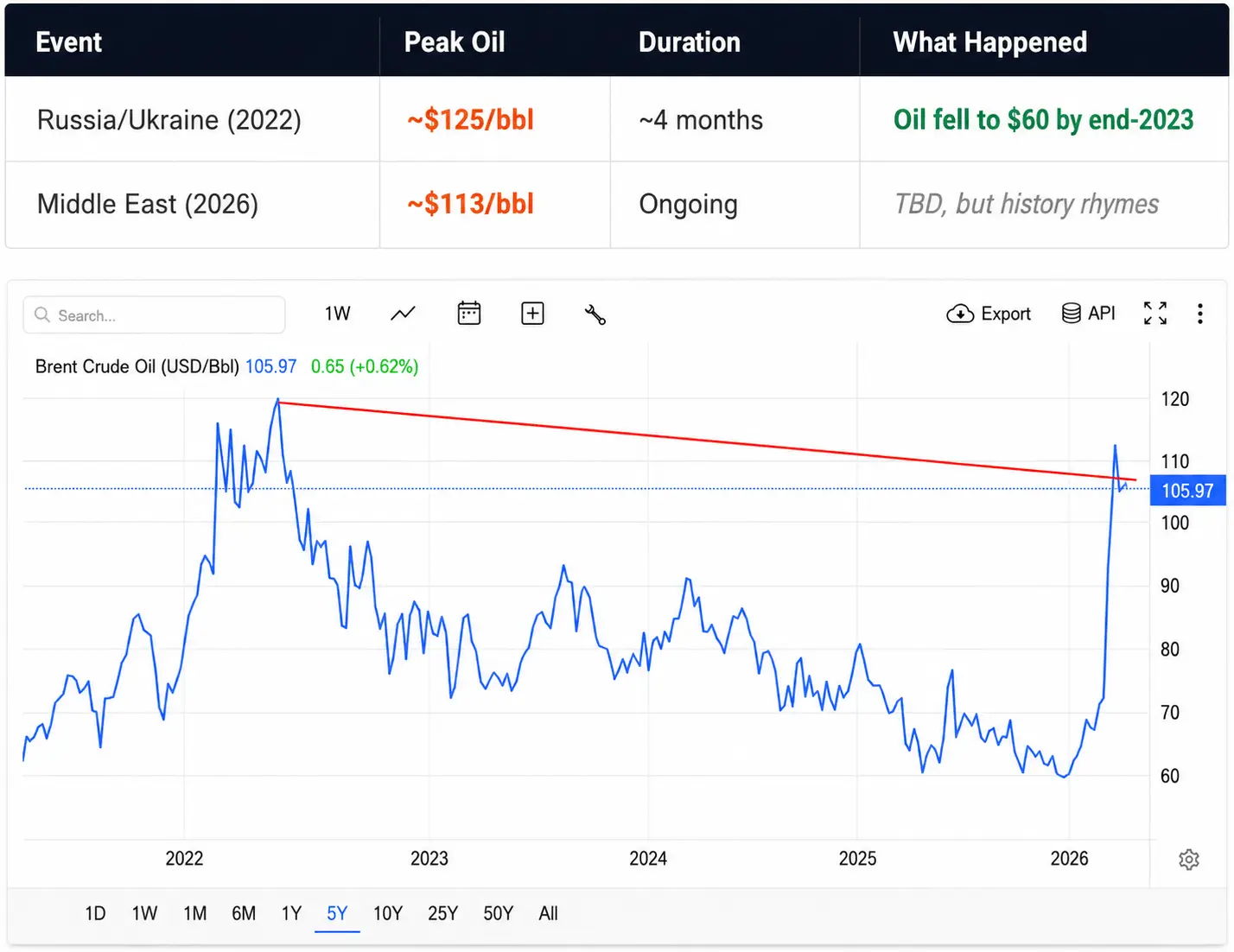
Look at what oil did this year. Escalating Middle East conflict pushed Brent crude above US$113 a barrel by late March, touching an intraday high near US$121 in late April, and petrol, freight and grocery costs all felt it. By late June the conflict had eased, tankers were moving through the Strait of Hormuz again, and Brent had collapsed back toward US$76. Then hostilities flared again, and as at 3 September 2026 Brent is back around US$95, up roughly 20% in a month.
Three violent turns in six months. Anyone who repositioned their portfolio to match each headline would have been wrong twice, paying transaction costs and locking in losses along the way. And we’ve seen this movie before: in mid 2022, the Russia-Ukraine war pushed oil above US$120, it stayed above US$100 for nearly four months, and by late 2023 it was back at US$60. The world did not end. Inflation peaked and came down.
That’s not blind optimism. It’s pattern recognition backed by decades of data: oil shocks, pandemics, wars, recessions and rate cycles have all felt overwhelming in the moment, and the noise has always been loudest right before it changed direction.
Why the cash instinct is so strong
The fear is real, and it deserves respect rather than dismissal. As Phil put it on the podcast, “that anxiety really kicks up when you’re going from having an income drop into your bank account every fortnight to that stopping.” Everybody knows somebody who lost 25 or 30% of their super in the GFC and had to keep working longer. Loss aversion is wired in: losing $100 feels roughly twice as painful as gaining $100.
So when your barbecue mate leans over with his absolute best advice, it usually sounds like Scott’s example from the podcast: “Mate, get out of the share market. Put it all in cash.” Scott’s follow-up is the bit worth remembering: “That advice could actually cost you hundreds of thousands of dollars.”
What the numbers actually say
Scott and Phil ran this properly in our episode on why playing it safe in retirement can cost you more. The worked example: a couple with $500,000 in super, spending $75,000 a year. A growth portfolio, with long-term expected returns around 6 to 7% per annum, funded their retirement into their late 90s. A conservative portfolio at 3 to 4% ran out roughly 15 years earlier. Same couple, same spending, same starting balance. The difference was the growth engine.
Please note: All figures, projections and scenarios in this article are approximate and for illustrative purposes only. Individual outcomes will vary based on personal circumstances, investment returns, fees, and current government policy. Past performance is not a reliable indicator of future results. This is general information, not personal advice.
There’s a second number that catches people. Miss the 10 best trading days over 20 years, and almost all of the market’s growth disappears. The catch is that the best days tend to cluster right next to the worst ones, so being out of the market during a scare usually means missing the rebound too. Getting the exit right is only half the trick. Nobody rings a bell for the re-entry.
Sequencing risk: the part that’s genuinely different near retirement
There is one version of this fear that deserves extra attention if you’re within a few years of retiring, and it’s called sequencing risk. The same 6% average return can produce wildly different outcomes depending on the order the returns arrive. A bad run in the first few years of retirement, while you’re drawing income, does far more damage than the same bad run at 80. In the podcast example, a poor sequence at the start wiped 10 years off a retirement’s funding, on identical average returns.
That’s a real risk, and it’s exactly why portfolio construction near retirement is about structure rather than switching. We generally find that staying invested through market dips leads to better long-term outcomes for most retirees, and that the anxiety is better handled by having a cash buffer and a spending plan sized to ride out a bad patch, rather than by moving the whole balance at the worst moment. How much buffer, and what mix, depends entirely on individual circumstances.
Scott and Phil also covered how rate rises hit supposedly safe conservative portfolios, with a lag of four to six months, in the episode on market chaos and why smart investors don’t panic. “Safe” and “cash-heavy” are not the same word.
The questions that matter in every cycle
The people who come out of volatile periods ahead tend to be focused on the same few things regardless of the headlines: what their cash flow looks like while costs rise, whether their debt position still makes sense at current rates, whether super contributions are staying consistent, and whether their asset mix matches their actual timeline rather than this month’s news. You don’t need to predict what oil does next. The goal is a plan that holds up regardless.
If you want to pressure-test your own numbers, run them through the free Wealthlab super calculator. Seeing how your balance, spending and timeline fit together does more for the anxiety than any headline ever will.
FAQ
Is it a good idea to move my super to cash during a market downturn? Generally, switching after markets have fallen crystallises losses and risks missing the rebound, and we generally find staying invested through dips leads to better long-term outcomes for most retirees. But whether any change suits you depends on your timeline, spending and circumstances, which is personal advice territory.
What is sequencing risk in retirement? Sequencing risk is the danger of poor returns arriving early in retirement while you’re withdrawing income. The same average return can fund a retirement or fall 10 years short depending purely on the order the good and bad years arrive, which is why the first few years around retirement matter most.
Why not just switch to cash and switch back when things improve? Because the market’s best days cluster around its worst ones, and missing just the 10 best days over 20 years can erase almost all growth. Timing the exit and the re-entry correctly, twice, under stress, is something even professionals reliably fail at.
Are conservative super options safe when interest rates rise? Not automatically. Rising rates tend to hurt bond-heavy conservative portfolios, typically with a four to six month lag, which is one reason “conservative” and “safe” aren’t interchangeable. Diversification across asset types matters more than any single label.
How do retirees handle market falls without switching to cash? A common structure is holding enough cash and defensive assets to cover near-term spending, so the growth assets have time to recover before they’re needed. The right split is individual, which is where personal advice comes in.
What happened to oil prices in 2026? Brent crude spiked above US$113 in March 2026 on Middle East conflict, touched near US$121 intraday in April, fell back toward US$76 by late June as the conflict eased, then rebounded to around US$95 by early September as hostilities resumed. Figures as at 3 September 2026. It’s a live example of how quickly market narratives reverse in both directions.
Feeling the pull toward the exit?
If the headlines have you refreshing your super balance and wondering whether to act, that’s exactly the moment a conversation helps most. Book a free chat with the Wealthlab team and talk it through before deciding anything. No pressure, no jargon. Our retirement planning approach starts with your timeline, not the news cycle.